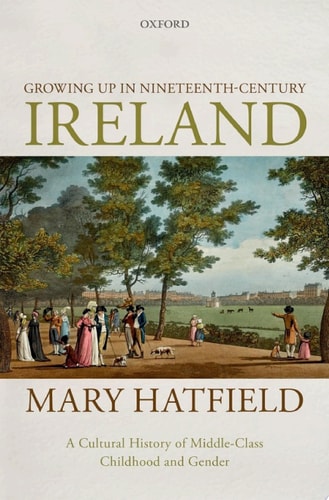
Growing Up in Nineteenth-Century Ireland: A Cultural History of Middle-Class Childhood and Gender
0
0
As an Amazon Associate and affiliate partner, Menrva Books earns from qualifying purchases. Learn more
Author Description
Why do we send children to school? Who should take responsibility for children's health and education? Should girls and boys be educated separately or together? These questions provoke much contemporary debate, but also have a longer, often-overlooked history. Mary Hatfield explores these questions and more in this comprehensive cultural history of childhood in nineteenth-century Ireland. Many modern ideas about Irish childhood have their roots in the first three-quarters of the nineteenth century, when an emerging middle-class took a disproportionate role in shaping the definition of a 'good' childhood. This study deconstructs several key changes in medical care, educational provision, and ideals of parental care. It takes an innovative holistic approach to the middle-class child's social world, by synthesising a broad base of documentary, visual, and material sources, including clothes, books, medical treatises, religious tracts, photographs, illustrations, and autobiographies. It offers invaluable new insights into Irish boarding schools, the material culture of childhood, and the experience of boys and girls in education.
Menrva's Summary
THE THESIS
This study investigates how the emerging middle class in nineteenth-century Ireland fundamentally reshaped societal definitions of childhood, education, and parental responsibility. Mary M. Hatfield utilizes a multidisciplinary approach to examine the evolution of medical care and educational structures during this period. By analyzing a diverse array of primary sources, the author argues that modern Irish concepts of childhood are deeply rooted in the specific social and material shifts occurring between 1800 and 1875.
THE SCOPE MAP
What You Will Find
- Analysis of nineteenth-century Irish boarding school systems and educational policies.
- Examination of the material culture of childhood, including clothing, books, and illustrations.
- Synthesis of medical treatises, religious tracts, and personal autobiographies.
- Comparative study of gendered experiences in education and domestic life.
Scope Limits
- The study focuses primarily on the middle-class experience and does not provide an exhaustive account of working-class or rural poverty-stricken childhoods.
- The chronological scope is limited to the first three-quarters of the nineteenth century.
THE AUTHORITY PERSPECTIVE
Scholars in the field of Irish social history recognize this work for its innovative use of material culture alongside traditional documentary evidence. Readers frequently note the academic density of the prose and the author's success in bridging the gap between educational history and gender studies.
Page Count:
295
Publication Date:
2019-01-01
Publisher:
OUP Oxford
ISBN-10:
0192581465
ISBN-13:
9780192581464
History
European History
Social History
Nineteenth century
Childhood Studies
Cultural History
Irish History
Gender Studies
Community Tags
Similar Books