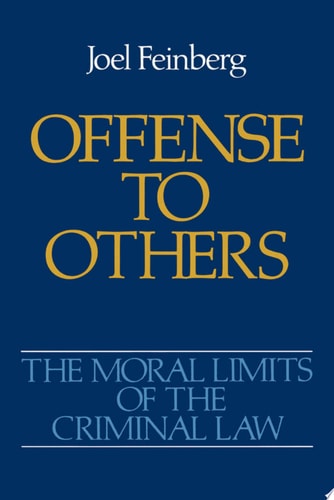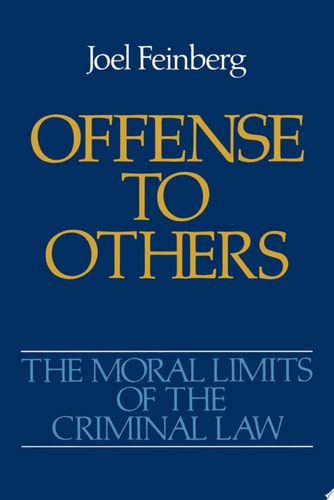
Offense to Others
0
0
As an Amazon Associate and affiliate partner, Menrva Books earns from qualifying purchases. Learn more
Author Description
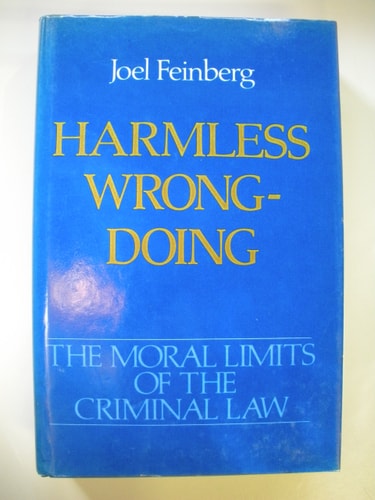
The second volume in Joel Feinberg's series The Moral Limits of the Criminal Law, Offense to Others focuses on the "offense principle," which maintains that preventing shock, disgust, or revulsion is always a morally relevant reason for legal prohibitions. Feinberg clarifies the concept of an "offended mental state" and further contrasts the concept of offense with harm. He also considers the law of nuisance as a model for statutes creating "morals offenses," showing its inadequacy as a model for understanding "profound offenses," and discusses such issues as obscene words and social policy, pornography and the Constitution, and the differences between minor and profound offenses.
Menrva's Summary
THE THESIS
This volume investigates whether the prevention of offense, distinct from the prevention of harm, constitutes a valid moral justification for the enactment of criminal law. Joel Feinberg, a prominent legal philosopher, utilizes analytical jurisprudence to dissect the "offense principle" and its application within a liberal society. By contrasting the psychological states of offense with tangible harm, he provides a rigorous framework for evaluating when state intervention is permissible in the regulation of public conduct.
THE SCOPE MAP
What You Will Find
- A detailed conceptual analysis of the "offended mental state" versus physical or economic harm.
- An evaluation of the law of nuisance as a potential, though ultimately inadequate, model for morals legislation.
- A critical examination of legal and constitutional issues surrounding pornography and obscene speech.
- A taxonomy of offense, distinguishing between minor annoyances and profound moral grievances.
THE AUTHORITY PERSPECTIVE
Legal scholars and philosophers frequently cite this work as a foundational text for understanding the boundaries of state authority in a pluralistic society. Readers often note the high level of analytical rigor and the systematic approach Feinberg employs to navigate complex intersections of morality and jurisprudence.
Page Count:
354
Publication Date:
1985-01-01
Publisher:
Oxford University Press
ISBN-10:
0199878609
ISBN-13:
9780199878604
Philosophy
Law
Ethics
Criminal Law