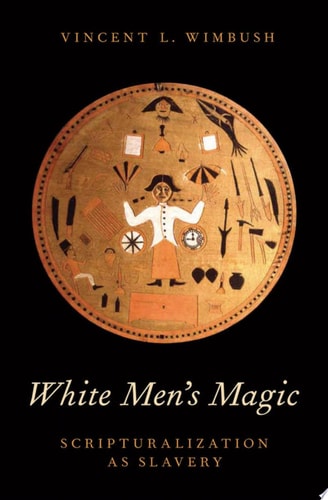
White Men's Magic: Scripturalization as Slavery
0
0
As an Amazon Associate and affiliate partner, Menrva Books earns from qualifying purchases. Learn more
Author Description
The Interesting Narrative of the Life of Olaudah Equiano, or Gustavus Vassa, the African, first published in England in 1789, was one of the earliest and remains to this day one of the best-known English language slave narratives. Characterizing Olaudah Equiano's eighteenth-century narrative of his life as a type of ''scriptural story'' that connects the Bible with identity formation, Vincent L. Wimbush's White Men's Magic probes not only how the Bible and its reading played a crucial role in the first colonial contacts between black and white persons in the North Atlantic but also the process and meaning of what he terms ''scripturalization.'' By this term, Wimbush means ''a social-psychological-political discursive structure'' or ''semiosphere'' that creates a reality and organizes a society in terms of relations and communications.This scripturalization, achieved by the British to establish a colonial and racialized society in and through the promotion of literacy and the Bible as a ''fetishized center-object,'' was also performed by an abject outsider or stranger like Equiano through his reading of the Bible as well as his own writing with the goal of imagining and promoting a more inclusive society. It is for this reason that Wimbush calls Equiano's narrative a ''scriptural story,'' and he argues that this is why the talking book trope appears repeatedly in writings of eighteenth- and early nineteenth-century black Atlantic writers. Because it is based on the particularities of Equiano's narrative, Wimbush's theoretical work is not only grounded but inductive, and shows that scripturalization is bigger than either the historical or the literary Equiano. Scripturalization was not invented by Equiano, he says, but it is not quite the same after Equiano.
Menrva's Summary
THE THESIS
This work investigates the role of scripturalization as a mechanism of colonial power and racial formation, specifically through the lens of Olaudah Equiano's eighteenth-century narrative. Vincent L. Wimbush, a scholar of religion and culture, utilizes Equiano's autobiography to analyze how the Bible functioned as a 'fetishized center-object' in the North Atlantic. He argues that scripturalization—a social-psychological-political discursive structure—was employed by colonial powers to organize society and was simultaneously reclaimed by marginalized individuals to imagine more inclusive social realities.
THE SCOPE MAP
What You Will Find
- An analysis of the 'scriptural story' as a tool for identity formation in the eighteenth-century black Atlantic.
- A theoretical framework defining scripturalization as a semiotic and political structure.
- Examination of the 'talking book' trope in early black Atlantic literature.
- Inductive research methodology grounded in the specific historical and literary details of Equiano's life.
THE AUTHORITY PERSPECTIVE
Scholars recognize this text as a significant contribution to the study of religion, race, and colonial discourse. Readers frequently note the academic density of the prose, which requires a strong background in critical theory and historical analysis to fully grasp the author's complex arguments.
Page Count:
312
Publication Date:
2012-05-02
Publisher:
Oxford University Press
ISBN-10:
0199873577
ISBN-13:
9780199873579
History
Religion
Literary Criticism
United States
Race Relations
Sociology
Community Tags
Similar Books