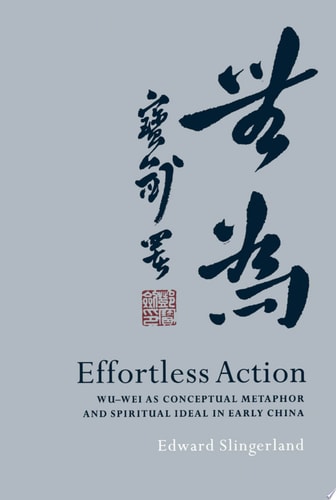
Effortless Action
0
0
As an Amazon Associate and affiliate partner, Menrva Books earns from qualifying purchases. Learn more
Author Description
This Book Presents A Systematic Account Of The Role Of The Personal Spiritual Ideal Of Wu-wei--literally No Doing, But Better Rendered As Effortless Action--in Early Chinese Thought. Edward Slingerland's Analysis Shows That Wu-wei Represents The Most General Of A Set Of Conceptual Metaphors Having To Do With A State Of Effortless Ease And Unself-consciousness. This Concept Of Effortlessness, He Contends, Serves As A Common Ideal For Both Daoist And Confucian Thinkers. He Also Argues That This Concept Contains Within Itself A Conceptual Tension That Motivates The Development Of Early Chinese Thought: The So-called Paradox Of Wu-wei, Or The Question Of How One Can Consciously Try Not To Try. Methodologically, This Book Represents A Preliminary Attempt To Apply The Contemporary Theory Of Conceptual Metaphor To The Study Of Early Chinese Thought. Although The Focus Is Upon Early China, Both The Subject Matter And Methodology Have Wider Implications. The Subject Of Wu-wei Is Relevant To Anyone Interested In Later East Asian Religious Thought Or In The So-called Virtue-ethics Tradition In The West. Moreover, The Technique Of Conceptual Metaphor Analysis--along With The Principle Of Embodied Realism Upon Which It Is Based--provides An Exciting New Theoretical Framework And Methodological Tool For The Study Of Comparative Thought, Comparative Religion, Intellectual History, And Even The Humanities In General. Part Of The Purpose Of This Work Is Thus To Help Introduce Scholars In The Humanities And Social Sciences To This Methodology, And Provide An Example Of How It May Be Applied To A Particular Sub-field.
Menrva's Summary
THE THESIS
This book investigates the conceptual paradox of wu-wei, or effortless action, as a foundational ideal in early Chinese philosophical traditions. Edward Slingerland, a scholar of East Asian thought, utilizes the framework of embodied realism and conceptual metaphor theory to analyze how Daoist and Confucian thinkers navigated the tension between conscious effort and spontaneous action. By examining historical texts through this cognitive lens, the author argues that the struggle to achieve unself-consciousness serves as a primary driver for the development of early Chinese intellectual history.
THE SCOPE MAP
What You Will Find
- A comprehensive analysis of the wu-wei concept within Daoist and Confucian philosophical frameworks.
- Application of conceptual metaphor theory to classical Chinese texts.
- A comparative study linking East Asian virtue ethics with Western philosophical traditions.
- A methodological guide for applying cognitive science principles to the humanities and intellectual history.
THE AUTHORITY PERSPECTIVE
Scholars and students of comparative religion and philosophy frequently cite this work as a rigorous application of cognitive linguistics to historical analysis. Experts highlight the text as a significant contribution to the field for its ability to bridge the gap between traditional sinology and contemporary cognitive science.
Page Count:
368
Publication Date:
2007-01-01
Publisher:
Oxford University Press
ISBN-10:
0199874573
ISBN-13:
9780199874576
Religion
History
Philosophy
Ethics
Community Tags
Similar Books