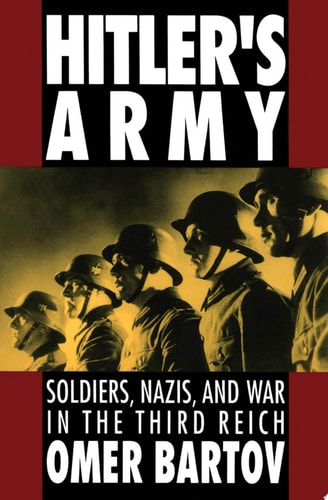
Hitler's Army: Soldiers, Nazis, and War in the Third Reich
0
0
As an Amazon Associate and affiliate partner, Menrva Books earns from qualifying purchases. Learn more
Author Description
As the Cold War followed on the heels of the Second World War, as the Nuremburg Trials faded in the shadow of the Iron Curtain, both the Germans and the West were quick to accept the idea that Hitler's army had been no SS, no Gestapo, that it was a professional force little touched by Nazi politics. But in this compelling account Omer Bartov reveals a very different history, as he probes the experience of the average soldier to show just how thoroughly Nazi ideology permeated the army.In Hitler's Army, Bartov focuses on the titanic struggle between Germany and the Soviet Union--where the vast majority of German troops fought--to show how the savagery of war reshaped the army in Hitler's image. Both brutalized and brutalizing, these soldiers needed to see their bitter sacrifices as noble patriotism and to justify their own atrocities by seeing their victims as subhuman. In the unprecedented ferocity and catastrophic losses of the Eastrn front, he writes, soldiers embraced the idea that the war was a defense of civilization against Jewish/Bolshevik barbarism, a war of racial survival to be waged at all costs. Bartov describes the incredible scale and destruction of the invasion of Russia in horrific detail. Even in the first months--often depicted as a time of easy victories--undermanned and ill-equipped German units were stretched to the breaking point by vast distances and bitter Soviet resistance. Facing scarce supplies and enormous casualties, the average soldier sank to ta a primitive level of existence, re-experiencing the trench warfare of World War I under the most extreme weather conditions imaginable; the fighting itself was savage, and massacres of prisoners were common. Troops looted food and supplies from civilians with wild abandon; they mercilessly wiped out villages suspected of aiding partisans. Incredible losses led to recruits being thrown together in units that once had been filled with men from the same communities, making Nazi ideology even more
Menrva's Summary
THE THESIS
This work investigates the extent to which Nazi ideology permeated the German Wehrmacht during the Second World War, challenging the post-war myth of a professional army untainted by political extremism. Omer Bartov, a historian specializing in the Holocaust and the German military, utilizes primary source materials including soldiers' letters, diaries, and military records to reconstruct the psychological and ideological environment of the Eastern Front. He argues that the brutal conditions of the war against the Soviet Union facilitated the radicalization of ordinary soldiers, who increasingly adopted Nazi racial doctrines to justify their own survival and the atrocities they committed.
THE SCOPE MAP
What You Will Find
- Analysis of the Eastern Front campaign between 1941 and 1945.
- Examination of the psychological impact of extreme attrition and supply shortages on unit cohesion.
- Use of primary source correspondence and personal diaries from German soldiers.
- Investigation into the intersection of racial ideology and military conduct in occupied territories.
THE AUTHORITY PERSPECTIVE
Historians and scholars of the Third Reich frequently cite this text as a foundational study for understanding the complicity of the German army in the Holocaust. Readers often note the academic density of the prose and the sobering nature of the evidence presented regarding the normalization of violence among frontline troops.
Page Count:
252
Publication Date:
1992-01-01
Publisher:
Oxford University Press
ISBN-10:
0199879613
ISBN-13:
9780199879618
History
Armed Forces
Military History
European History
Community Tags
Other Editions(2)
Similar Books

Reader Comments
Share Your Thoughts
No comments yet. Be the first to share your thoughts!