Sovereignty Across Generations: Constituent Power and Political Liberalism
0
0
As an Amazon Associate and affiliate partner, Menrva Books earns from qualifying purchases. Learn more
Author Description
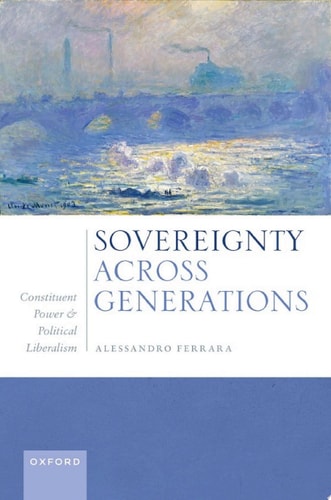
Every cohort of voters may dream of being 'the people' under the sway of serial visions of sovereignty; or understand itself, more modestly, as co-author of a constitutional project in a cross-generational sequence rooted in the past and extending into the future. Sovereignty Across Generations offers a theory of democratic sovereignty and constituent power grounded in John Rawls's political liberalism. Neither exegetic nor abstractly analytic, this book assumes that 'political liberalism' is broader than Political Liberalism. In answering the question 'How is it possible for there to exist over time a just and stable society of free and equal citizens, who remain profoundly divided by reasonable religious, philosophical, and moral doctrines?', the paradigm implicit in Political Liberalism enables us to address facets of that question that Rawls sidelined in the context of his time. Following populist threats to democracy, which were still latent in 1993, this book responds to the urgency of clarifying the proper relation of 'the people' (as transgenerational author of the constitution) to its pro-tempore living segment in its capacity as electorate and as co-author of the constitution. An explanation of that relation brings 'constituent power' into the picture and unfolds in seven steps that form the conceptual backbone of this book. By taking new steps in updating and revisiting political liberalism, this book reconstructs Rawls's implicit view of constituent power beyond the pages dedicated to it in Political Liberalism and brings that view into conversation with major constitutional theories of the twentieth century. This book is a must read for all those interested in the fields of politics, philosophy, and constitutional law.
Menrva's Summary
THE THESIS
This book investigates how democratic sovereignty and constituent power can be reconciled within a cross-generational framework using the principles of political liberalism. Alessandro Ferrara, a scholar of political philosophy, utilizes the framework established by John Rawls to address the stability of just societies over time. The author argues that the current understanding of 'the people' must be expanded to include both the past and future, rather than focusing solely on the contemporary electorate, to counter modern populist threats to democratic institutions.
THE SCOPE MAP
What You Will Find
- A seven-step conceptual framework for understanding constituent power.
- An analysis of the relationship between the transgenerational 'people' and the pro-tempore electorate.
- A comparative study between Rawlsian political liberalism and twentieth-century constitutional theories.
Scope Limits
- The text does not provide a comprehensive history of all democratic movements.
- It does not offer a practical policy manual for day-to-day governance.
THE AUTHORITY PERSPECTIVE
Scholars in political theory and constitutional law view this work as a rigorous extension of Rawlsian thought into contemporary democratic challenges. Readers frequently note the academic density of the prose, which requires a strong background in political philosophy to fully engage with the author's arguments.
Page Count:
326
Publication Date:
2023-01-01
Publisher:
OUP Oxford
ISBN-10:
0192698761
ISBN-13:
9780192698766
Liberalism
Professional Career & Trade
Constitutional Law
Political Philosophy
Democratic Theory
Community Tags
Similar Books