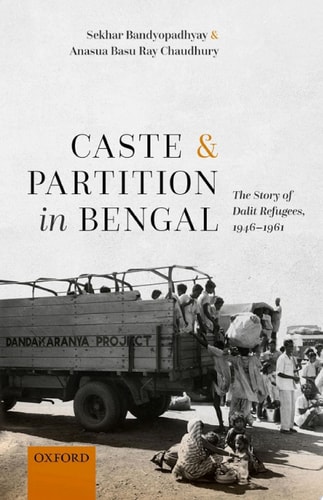
Caste and Partition in Bengal: The Story of Dalit Refugees, 1946-1961
0
0
As an Amazon Associate and affiliate partner, Menrva Books earns from qualifying purchases. Learn more
Author Description
The book seeks to situate caste as a discursive category in the discussion of Partition in Bengal. In conventional narratives of Partition, the role of the Dalit or the Scheduled Castes is either completely ignored or mentioned in passing. The authors addresse this discursive absence and argues that in Bengal the Dalits were neither passive onlookers nor accidental victims of Partition politics and violence, which ruptured their unity and weakened their political autonomy. They were the worst victims of Partition. When the Dalit peasants of Eastern Bengal began to migrate to India after 1950, they were seen as the 'burden' of a frail economy of West Bengal, and the Indian state did not provide them with a proper rehabilitation package. They were first segregated in fenced refugee camps where life was unbearable, and then dispersed to other parts of India - first to the Andaman Islands and the neighbouring states, and then to the inhospitable terrains of Dandakaranya, where they could be used as cheap labour for various development projects. This book looks critically at their participation in Partition politics, the reasons for their migration three years after Partition, their insufferable life and struggles in the refugee camps, their negotiations with caste and gender identities in these new environments, their organized protests against camp maladministration, and finally their satyagraha campaigns against the Indian state's refugee dispersal policy. This book looks at how refugee politics impacted Dalit identity and protest movements in post-Partition West Bengal.
Menrva's Summary
THE THESIS
This book investigates the role of caste as a critical, yet historically neglected, factor in the experience and political aftermath of the 1947 Partition of Bengal. The authors, Anasua Basu Ray Chaudhury and Sekhar Bandyopadhyay, utilize archival research and historical analysis to challenge the conventional narrative that positions Dalits as passive victims. They argue that Dalit populations were active participants in political negotiations whose autonomy was systematically undermined by state policies and economic marginalization during the post-Partition era.
THE SCOPE MAP
What You Will Find
- Historical analysis of Dalit migration patterns between 1950 and 1961
- Documentation of refugee camp conditions and state-led dispersal policies
- Examination of organized protest movements and satyagraha campaigns
- Intersectionality of caste, gender, and refugee identity in West Bengal
Scope Limits
- The study focuses specifically on the Bengal region and the subsequent dispersal to Dandakaranya and the Andaman Islands
- The analysis is bounded by the years 1946 to 1961
THE AUTHORITY PERSPECTIVE
Scholars in South Asian history recognize this work as a significant intervention that corrects the erasure of Dalit experiences in Partition historiography. Readers frequently note the academic rigor and the depth of primary source utilization, making it a foundational text for understanding the intersection of caste and displacement in post-colonial India.
Page Count:
200
Publication Date:
2022-01-01
Publisher:
OUP Oxford
ISBN-10:
0192675826
ISBN-13:
9780192675828
History
Sociology
Dalit Studies
Asia history
Asian History
Asian Studies
Migration Studies
Community Tags
Similar Books