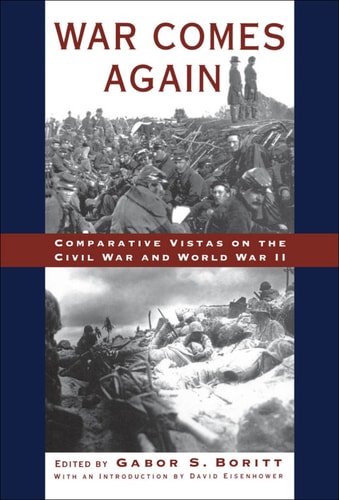
War Comes Again: Comparative Vistas on the Civil War and World War II
0
0
As an Amazon Associate and affiliate partner, Menrva Books earns from qualifying purchases. Learn more
Author Description
The Civil War and the World War II stand as the two great cataclysms of American history. They were our two costliest wars, with well over a million casualties suffered in each. And they were transforming moments in our history as well, times when the life of the nation and the great experiment in democracy--government of the people, by the people, for the people--seemed to hang in the balance. Now, in War Comes Again, eleven eminent historians--including three Pulitzer Prize winners, all veterans of the Second World War--offer an illuminating comparison of these two epic events in our national life.The range of essays here is remarkable, the level of insight consistently high, and the quality of the writing is superb. For instance, Stephen Ambrose, the bestselling author of D-Day, June 6th, 1944, offers an intriguing comparison of the two great military leaders of each war--Grant and Eisenhower. Pulitzer Prize-winning historian Robert V. Bruce takes a revealing look at the events that foreshadowed the two wars. Gerald Linderman, author of Embattled Courage, examines the two wars from the point of view of the combat soldier. And Arthur Schlesinger, Jr., describes how both Lincoln and FDR went around strict observance of the Constitution in order to preserve the Constitution. There is, in addition, a fascinating discussion of the crucial role played by spying during the two wars, by Peter Maslowski; a look at the diplomacy of Lincoln and Roosevelt, by Howard Jones; and essays on the impact of the wars on women and on African Americans, by D'Ann Campbell, Richard Jensen, and Ira Berlin. In perhaps the most gripping piece in the book, Michael C.C. Adams offers an unflinching look at war's destructiveness, as he argues that the evils we associate with "bad wars" (such as Vietnam) are equally true of "good wars." And finally, in perhaps the most provocative essay in the book, Russell Weigley, one of America's most eminent military historians, maps the evolution of Americ
Menrva's Summary
THE THESIS
This volume investigates the structural and societal parallels between the American Civil War and World War II to determine how these two cataclysmic events reshaped the American democratic experiment. Edited by David Eisenhower and Gabor Boritt, the collection features contributions from eleven distinguished historians, many of whom are veterans of the Second World War. The authors utilize comparative historical analysis to examine how both conflicts tested the limits of the Constitution and the resilience of the American populace.
THE SCOPE MAP
What You Will Find
- Comparative analysis of military leadership styles, specifically focusing on Ulysses S. Grant and Dwight D. Eisenhower.
- Examination of executive power and constitutional adherence under Abraham Lincoln and Franklin D. Roosevelt.
- Sociological studies regarding the impact of total war on women, African Americans, and the individual combat soldier.
- Historical assessment of intelligence gathering, diplomacy, and the inherent destructiveness of warfare.
THE AUTHORITY PERSPECTIVE
Historians and scholars frequently cite this collection as a significant contribution to comparative military studies, noting the high caliber of the contributors. Readers often highlight the academic rigor of the essays, which provide a nuanced perspective on the evolution of American warfare and national identity.
Page Count:
305
Publication Date:
1995-01-01
Publisher:
Oxford University Press
ISBN-10:
0199879842
ISBN-13:
9780199879847
History
Military History
Civil War
American History
Community Tags
Other Editions(2)
Similar Books















Reader Comments
Share Your Thoughts
No comments yet. Be the first to share your thoughts!