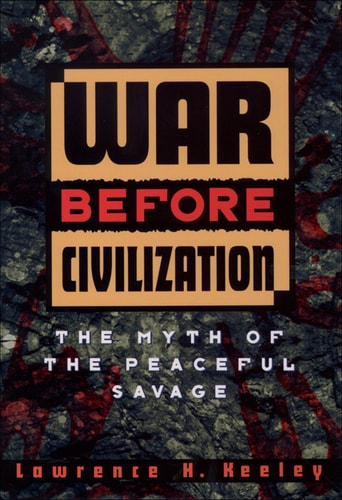
War before Civilization
0
0
As an Amazon Associate and affiliate partner, Menrva Books earns from qualifying purchases. Learn more
Author Description
The myth of the peace-loving "noble savage" is persistent and pernicious. Indeed, for the last fifty years, most popular and scholarly works have agreed that prehistoric warfare was rare, harmless, unimportant, and, like smallpox, a disease of civilized societies alone. Prehistoric warfare, according to this view, was little more than a ritualized game, where casualties were limited and the effects of aggression relatively mild. Lawrence Keeley's War Before Civilization offers a rebuttal to such comfortable myths and debunks the notion that warfare was introduced to primitive societies through contact with civilization (an idea he denounces as "the pacification of the past"). Building on much fascinating archeological and historical research and offering an astute comparison of warfare in civilized and prehistoric societies, from modern European states to the Plains Indians of North America, War Before Civilization convincingly demonstrates that prehistoric warfare was in fact more deadly, more frequent, and more ruthless than modern war. To support this point, Keeley provides a wide-ranging look at warfare and brutality in the prehistoric world. He reveals, for instance, that prehistorical tactics favoring raids and ambushes, as opposed to formal battles, often yielded a high death-rate; that adult males falling into the hands of their enemies were almost universally killed; and that surprise raids seldom spared even women and children. Keeley cites evidence of ancient massacres in many areas of the world, including the discovery in South Dakota of a prehistoric mass grave containing the remains of over 500 scalped and mutilated men, women, and children (a slaughter that took place a century and a half before the arrival of Columbus). In addition, Keeley surveys the prevalence of looting, destruction, and trophy-taking in all kinds of warfare and again finds little moral distinction between ancient warriors and civilized armies.
Menrva's Summary
THE THESIS
Does the archaeological and historical record support the long-standing academic myth that prehistoric societies were inherently peaceful and that warfare is a byproduct of civilization? Lawrence H. Keeley, a professor of anthropology, utilizes extensive archaeological data and cross-cultural comparisons to challenge the 'noble savage' narrative. He argues that prehistoric warfare was not a ritualized game but a frequent, lethal, and ruthless reality that often exceeded the intensity of modern conflict. By examining skeletal remains, settlement patterns, and historical accounts of non-state societies, Keeley constructs a rigorous argument that violence is a persistent feature of human history rather than a recent invention.
THE SCOPE MAP
What You Will Find
- Comparative analysis of casualty rates between prehistoric raids and modern state-level warfare.
- Archaeological evidence from mass graves, including the Crow Creek site in South Dakota.
- Examination of tactical patterns such as ambushes, surprise raids, and the targeting of non-combatants.
- Synthesis of ethnographic data regarding trophy-taking, looting, and the treatment of prisoners in primitive societies.
THE AUTHORITY PERSPECTIVE
Scholars and readers frequently cite this work as a pivotal challenge to the romanticized view of pre-state societies. While some critics engage with the author's interpretation of specific archaeological data, the text remains a foundational reference for those studying the origins and prevalence of human conflict.
Page Count:
377
Publication Date:
1997-12-18
Publisher:
Oxford University Press
ISBN-10:
0199880700
ISBN-13:
9780199880706
History
Sociology
General Anthropology
Military History
Archaeology
Anthropology
Warfare
Community Tags
Other Editions(3)

Similar Books















Reader Comments
Share Your Thoughts
No comments yet. Be the first to share your thoughts!