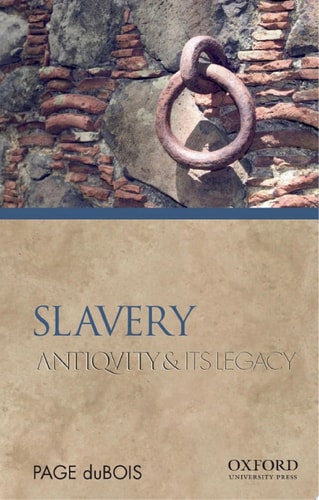
Slavery: Antiquity and Its Legacy
0
0
As an Amazon Associate and affiliate partner, Menrva Books earns from qualifying purchases. Learn more
Author Description
"Life, liberty and the pursuit of happiness" is perhaps the most famous phrase of all in the American Declaration of Independence. Thomas Jefferson's momentous words are closely related to the French concept of "liberté, égalité, fraternityé"; and both ideas incarnate a notion of freedom as inalienable human right that in the modern world we expect to take for granted. In the ancient world, by contrast, the concepts of freedom and equality had little purchase. Athenians, Spartans and Romans all possessed slaves or helots (unfree bondsmen), and society was unequal at every stratum. Why, then, if modern society abominates slavery, does what antiquity thought about serfdom matter today?Page duBois shows that slavery, far from being extinct, is alive and well in the contemporary era. Slaves are associated not just with the Colosseum of ancient Rome, and films depicting ancient slaves, but also with Californian labor factories and south Asian sweatshops, while young women and children appear increasingly vulnerable to sexual trafficking. Juxtaposing such modern experiences of bondage (economic or sexual) with slavery in antiquity, the author explores the writings on the subject of Aristotle, Plautus, Terence and Aristophanes. She also examines the case of Spartacus, famous leader of a Roman slave rebellion, and relates ancient notions of liberation to the all-too-common immigrant experience of enslavement to a globalized world of rampant corporatism and exploitative capitalism.
Menrva's Summary
THE THESIS
This book investigates the enduring presence of slavery in the modern world by contrasting contemporary forms of bondage with the institutionalized servitude of ancient Greece and Rome. Page duBois, a scholar of classics, utilizes historical texts and sociological analysis to argue that the ancient conceptualization of slavery remains relevant to understanding modern economic and sexual exploitation. By examining the works of classical authors alongside current global labor conditions, she demonstrates how historical frameworks of inequality continue to inform modern power structures.
THE SCOPE MAP
What You Will Find
- Comparative analysis of ancient Roman and Greek slavery versus modern labor exploitation.
- Interpretations of classical texts by Aristotle, Plautus, Terence, and Aristophanes.
- Examination of the historical and symbolic legacy of the Spartacus slave rebellion.
- Critique of globalized capitalism and its role in modern human trafficking and economic bondage.
THE AUTHORITY PERSPECTIVE
Scholars and readers note the text's ability to bridge the gap between classical studies and contemporary political discourse. The prose is recognized for its analytical rigor and its provocative application of historical theory to current human rights issues.
Page Count:
165
Publication Date:
2010-01-01
Publisher:
Oxford University Press
ISBN-10:
0199888698
ISBN-13:
9780199888696
History
Human rights
Social Science
Ancient History
Community Tags
Similar Books