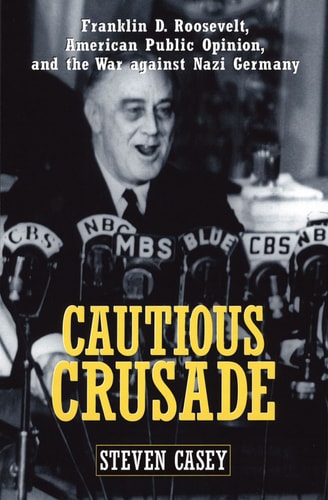
Cautious Crusade: Franklin D. Roosevelt, American Public Opinion, and the War against Nazi Germany
0
0
As an Amazon Associate and affiliate partner, Menrva Books earns from qualifying purchases. Learn more
Author Description
America's struggle against Nazism is one of the few aspects of World War II that has escaped controversy. Historians agree that it was a widely popular war, different from the subsequent conflicts in Korea and Vietnam because of the absence of partisan sniping, ebbing morale, or calls for a negotiated peace. In this provocative book, Steven Casey challenges conventional wisdom about America's participation in World War II. Drawing on the numerous opinion polls and surveys conducted by the U.S. government, he traces the development of elite and mass attitudes toward Germany, from the early days of the war up to its conclusion. Casey persuasively argues that the president and the public rarely saw eye to eye on the nature of the enemy, the threat it posed, or the best methods for countering it. He describes the extensive propaganda campaign that Roosevelt designed to build support for the war effort, and shows that Roosevelt had to take public opinion into account when formulating a host of policies, from the Allied bombing campaign to the Morgenthau plan to pastoralize the Third Reich. By examining the previously unrecognized relationship between public opinion and policy making during World War II, Casey's groundbreaking book sheds new light on a crucial era in American history.
Menrva's Summary
THE THESIS
This book investigates the complex, often discordant relationship between Franklin D. Roosevelt and the American public regarding the strategic conduct of the war against Nazi Germany. Steven Casey, a historian specializing in international relations, utilizes archival data from government opinion polls and surveys to challenge the historical consensus that the American war effort enjoyed uniform, unquestioned support. He argues that Roosevelt operated under significant constraints, forced to navigate a skeptical or misaligned public through sophisticated propaganda and careful policy calibration.
THE SCOPE MAP
What You Will Find
- Analysis of U.S. government opinion polls and surveys conducted between 1939 and 1945.
- Examination of the propaganda mechanisms employed by the Roosevelt administration to shape domestic consensus.
- Case studies on specific policy initiatives, including the Allied bombing campaigns and the Morgenthau plan.
- Evaluation of the disconnect between elite strategic planning and mass public perception of the Nazi threat.
THE AUTHORITY PERSPECTIVE
Historians and political scientists recognize this work as a significant revisionist study that complicates the traditional narrative of American unity during World War II. Scholars frequently cite the text for its meticulous use of primary source polling data to illustrate the limitations of presidential power in a democratic wartime state.
Page Count:
327
Publication Date:
2001-01-01
Publisher:
Oxford University Press
ISBN-10:
0199881502
ISBN-13:
9780199881505
History
United States
Military History
American History
Public Policy
Public opinion