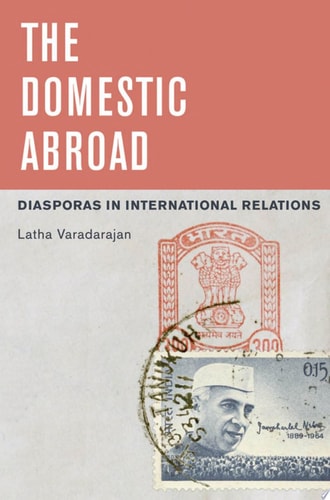
The Domestic Abroad: Diasporas in International Relations
0
0
As an Amazon Associate and affiliate partner, Menrva Books earns from qualifying purchases. Learn more
Author Description
In the past few decades, and across disparate geographical contexts, states have adopted policies and initiatives aimed at institutionalizing relationships with "their" diasporas. These practices, which range from creating new ministries to granting dual citizenship, are aimed at integrating diasporas as part of a larger "global" nation that is connected to, and has claims on the institutional structures of the home state. Although links, both formal and informal, between diasporas and their presumptive homelands have existed in the past, the recent developments constitute a far more widespread and qualitatively different phenomenon.In this book, Latha Varadarajan theorizes this novel and largely overlooked trend by introducing the concept of the "domestic abroad." Varadarajan demonstrates that the remapping of the imagined boundaries of the nation, the visible surface of the phenomenon, is intrinsically connected to the political-economic transformation of the state that is typically characterized as "neoliberalism." The domestic abroad must therefore be understood as the product of two simultaneous, on-going processes: the diasporic re-imagining of the nation and the neoliberal restructuring of the state.The argument unfolds through a historically nuanced study of the production of the domestic abroad in India. The book traces the complex history and explains the political logic of the remarkable transition from the Indian state's guarded indifference toward its diaspora in the period after independence, to its current celebrations of the "global Indian nation." In doing so, The Domestic Abroad reveals the manner in which the boundaries of the nation and the extent of the authority of the state, in India and elsewhere, are dynamically shaped by the development of capitalist social relations on both global and national scales.
Menrva's Summary
THE THESIS
This book investigates the political and economic mechanisms behind the modern state's efforts to institutionalize relationships with its diaspora populations. Latha Varadarajan, a scholar of international relations, argues that the emergence of the "domestic abroad" is not merely a cultural phenomenon but a direct consequence of neoliberal state restructuring. By analyzing the shift in India's policy toward its diaspora, the author demonstrates how states redefine national boundaries to integrate global populations into their political-economic frameworks. The work posits that these changes are inextricably linked to the development of capitalist social relations on both national and global scales.
THE SCOPE MAP
What You Will Find
- A theoretical framework defining the "domestic abroad" as a product of diasporic re-imagining and neoliberal state restructuring.
- A historical analysis of India's policy transition from post-independence indifference to active engagement with the global Indian nation.
- Examination of institutional mechanisms such as dual citizenship and the creation of specialized government ministries.
- Discussion on how capitalist social relations influence the territorial and conceptual boundaries of the modern nation-state.
THE AUTHORITY PERSPECTIVE
Experts in international relations and political sociology identify this work as a critical contribution to the study of statecraft and globalization. Readers frequently note the academic density of the prose, which provides a rigorous, historically grounded analysis of how states adapt to globalized populations.
Page Count:
254
Publication Date:
2010-01-01
Publisher:
Oxford University Press
ISBN-10:
0199889872
ISBN-13:
9780199889877
History
Neoliberalism
Sociology
International relations
World Civilization
Hegemony
Developing Countries
Nationalism
Globalization
East Indians
India
Liberalism
Community Tags
Similar Books