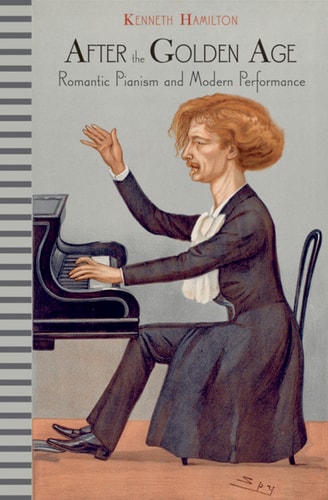
After the Golden Age: Romantic Pianism and Modern Performance
0
0
As an Amazon Associate and affiliate partner, Menrva Books earns from qualifying purchases. Learn more
Author Description
Kenneth Hamilton's book engagingly and lucidly dissects the oft-invoked myth of a Great Tradition, or Golden Age of Pianism. It is written both for players and for members of their audiences by a pianist who believes that scholarship and readability can go hand-in-hand. Hamilton discusses in meticulous yet lively detail the performance-style of great pianists from Liszt to Paderewski, and delves into the far-from-inevitable development of the piano recital. He entertainingly recounts how classical concerts evolved from exuberant, sometimes riotous events into the formal, funereal trotting out of predictable pieces they can be today, how an often unhistorical "respect for the score" began to replace pianists' improvisations and adaptations, and how the clinical custom arose that an audience should be seen and not heard. Pianists will find food for thought here on their repertoire and the traditions of its performance. Hamilton chronicles why pianists of the past did not always begin a piece with the first note of the score, nor end with the last. He emphasizes that anxiety over wrong notes is a relatively recent psychosis, and playing entirely from memory a relatively recent requirement. Audiences will encounter a vivid account of how drastically different are the recitals they attend compared to concerts of the past, and how their own role has diminished from noisily active participants in the concert experience to passive recipients of artistic benediction from the stage. They will discover when cowed listeners eventually stopped applauding between movements, and why they stopped talking loudly during them. The book's broad message proclaims that there is nothing divinely ordained about our own concert-practices, programming and piano-performance styles. Many aspects of the modern approach are unhistorical-some laudable, some merely ludicrous. They are also far removed from those fondly, if deceptively, remembered as constituting a Golden Age.
Menrva's Summary
THE THESIS
This work investigates the historical evolution of piano performance practices to challenge the myth of a singular, divinely ordained 'Golden Age' of pianism. Kenneth Hamilton, a professional pianist and scholar, utilizes historical concert records, contemporary accounts, and performance scores to deconstruct modern performance norms. He argues that current expectations—such as strict adherence to the score, silent audiences, and playing from memory—are relatively recent developments rather than timeless traditions. By examining the transition from the exuberant, improvisational concerts of the 19th century to the formal recitals of today, Hamilton provides a framework for understanding the fluidity of musical performance history.
THE SCOPE MAP
What You Will Find
- Historical analysis of performance styles from the era of Liszt to Paderewski.
- Examination of the evolution of the piano recital format and audience etiquette.
- Discussion on the shift from improvisational performance to rigid score adherence.
- Critical evaluation of modern performance requirements like playing from memory and the avoidance of wrong notes.
THE AUTHORITY PERSPECTIVE
Experts and musicologists frequently cite this text as a vital challenge to conventional wisdom regarding classical performance history. Readers often note the accessible prose style, which balances rigorous academic research with the practical insights of a performing musician.
Page Count:
320
Publication Date:
2007-01-01
Publisher:
Oxford University Press
ISBN-10:
0199884390
ISBN-13:
9780199884391
Music
Humanities
Music History
Piano
Performance art
Community Tags
Other Editions(2)
Similar Books

Reader Comments
Share Your Thoughts
No comments yet. Be the first to share your thoughts!