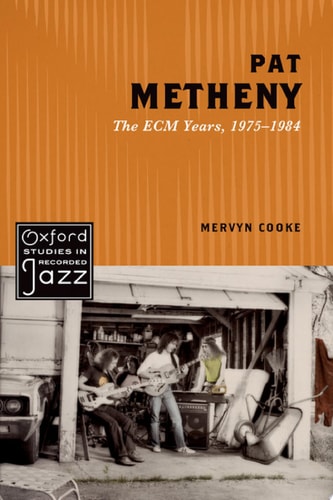
Pat Metheny: The ECM Years, 1975-1984
0
0
As an Amazon Associate and affiliate partner, Menrva Books earns from qualifying purchases. Learn more
Author Description
The guitarist and composer Pat Metheny ranks among the most popular and innovative jazz musicians of all time. In Pat Metheny: The ECM Years, 1975-1984, Mervyn Cooke offers the first in-depth account of Metheny's early creative period, during which he recorded eleven stunningly varied albums for the pioneering European record label ECM (Edition of Contemporary Music). This impressive body of recordings encompasses both straight-ahead jazz playing with virtuosic small ensembles and the increasingly complex textures and structures of the Pat Metheny Group, a hugely successful band also notable for its creative exploration of advanced music technologies which were state-of-the-art at the time.Metheny's music in all its shapes and forms broke major new ground in its refusal to subscribe to either of the stylistic poles of bebop and jazz-rock fusion which prevailed in the late 1970s. Through a series of detailed analyses based on a substantial body of new transcriptions from the recordings, this study reveals the close interrelationship of improvisation and pre-composition which lies at the very heart of the music. Furthermore, these analyses vividly demonstrate how Metheny's music is often conditioned by a strongly linear narrative model: both its story-telling characteristics and atmospheric suggestiveness have sometimes been compared to those of film music, a genre in which the guitarist also became active during this early period. The melodic memorability for which Metheny's compositions and improvisations have long been world-renowned is shown to be just one important element in an unusually rich and flexible musical language that embraces influences as diverse as bebop, free jazz, rock, pop, country & western, Brazilian music, classical music, minimalism, and the avant-garde. These elements are melded into a uniquely distinctive soundworld which, above all, directly reflects Metheny's passionate belief in the need to refashion jazz in ways which can allow it to spe
Menrva's Summary
THE THESIS
This study investigates the stylistic evolution and compositional methodology of Pat Metheny during his formative decade with the ECM label. Mervyn Cooke, a scholar of music history, utilizes a rigorous analytical framework to examine how Metheny synthesized disparate genres—from bebop to country and minimalism—into a cohesive musical identity. By focusing on the interplay between improvisation and pre-composition, the author argues that Metheny’s work during this period established a new paradigm for jazz that transcended the binary of traditional bebop and jazz-rock fusion.
THE SCOPE MAP
What You Will Find
- Detailed musicological analysis of eleven albums recorded for ECM between 1975 and 1984.
- Examination of the Pat Metheny Group’s integration of advanced music technologies.
- Discussion of the influence of film music aesthetics on Metheny’s linear narrative structures.
Scope Limits
- The analysis is strictly confined to the period between 1975 and 1984.
- The text does not provide a comprehensive biography of Metheny’s life outside of his recording career.
THE AUTHORITY PERSPECTIVE
Musicologists and jazz critics recognize this work as a primary resource for understanding the technical foundations of Metheny's early output. Readers frequently note the academic density of the prose, which relies heavily on musical transcriptions to support its arguments.
Page Count:
322
Publication Date:
2017-01-01
Publisher:
Oxford University Press
ISBN-10:
0190651903
ISBN-13:
9780190651909
Music
Biography
Musicology
Humanities
Music History
Jazz
Community Tags
Similar Books