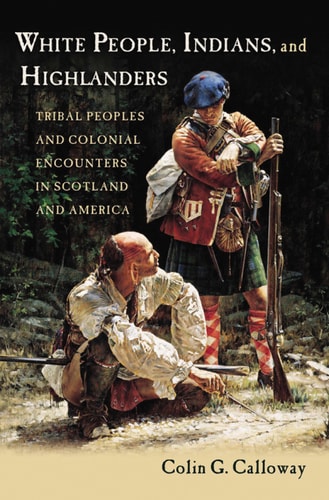
White People, Indians, and Highlanders: Tribal People and Colonial Encounters in Scotland and America
0
0
As an Amazon Associate and affiliate partner, Menrva Books earns from qualifying purchases. Learn more
Author Description
In nineteenth century paintings, the proud Indian warrior and the Scottish Highland chief appear in similar ways--colorful and wild, righteous and warlike, the last of their kind. Earlier accounts depict both as barbarians, lacking in culture and in need of civilization. By the nineteenth century, intermarriage and cultural contact between the two--described during the Seven Years' War as cousins--was such that Cree, Mohawk, Cherokee, and Salish were often spoken with Gaelic accents. In this imaginative work of imperial and tribal history, Colin Calloway examines why these two seemingly wildly disparate groups appear to have so much in common. Both Highland clans and Native American societies underwent parallel experiences on the peripheries of Britain's empire, and often encountered one another on the frontier. Indeed, Highlanders and American Indians fought, traded, and lived together. Both groups were treated as tribal peoples--remnants of a barbaric past--and eventually forced from their ancestral lands as their traditional food sources--cattle in the Highlands and bison on the Great Plains--were decimated to make way for livestock farming. In a familiar pattern, the cultures that conquered them would later romanticize the very ways of life they had destroyed. White People, Indians, and Highlanders illustrates how these groups alternately resisted and accommodated the cultural and economic assault of colonialism, before their eventual dispossession during the Highland Clearances and Indian Removals. What emerges is a finely-drawn portrait of how indigenous peoples with their own rich identities experienced cultural change, economic transformation, and demographic dislocation amidst the growing power of the British and American empires.
Menrva's Summary
THE THESIS
This work investigates the parallel historical experiences of Scottish Highlanders and Native American tribes as they navigated the expansion of the British and American empires. Colin G. Calloway, a prominent historian of Native American history, utilizes a comparative framework to analyze how both groups were marginalized, displaced, and eventually romanticized by the colonial powers that sought to dismantle their traditional ways of life. By examining the intersection of these two cultures on the frontier, the author argues that their shared status as 'tribal peoples' led to similar patterns of resistance, economic transformation, and eventual dispossession.
THE SCOPE MAP
What You Will Find
- Comparative analysis of the Highland Clearances and American Indian Removals.
- Examination of cultural and economic interactions between Highlanders and various tribes including the Cherokee, Mohawk, and Salish.
- Historical evidence drawn from colonial records, accounts of the Seven Years' War, and nineteenth-century artistic representations.
- Analysis of the colonial process of romanticizing indigenous cultures after their destruction.
THE AUTHORITY PERSPECTIVE
Historians and scholars of colonial studies frequently cite this work as a significant contribution to comparative imperial history. Readers often note the clarity of Calloway's prose and the effectiveness of his interdisciplinary approach in connecting two seemingly disparate historical subjects.
Page Count:
368
Publication Date:
2008-01-01
Publisher:
Oxford University Press
ISBN-10:
0199887640
ISBN-13:
9780199887644
History
Scottish History
American History
History of the Americas
Imperialism
Cultural History
Great Britain
Scotland
North America
America history
Canadian History
Colonialism
Community Tags
Similar Books