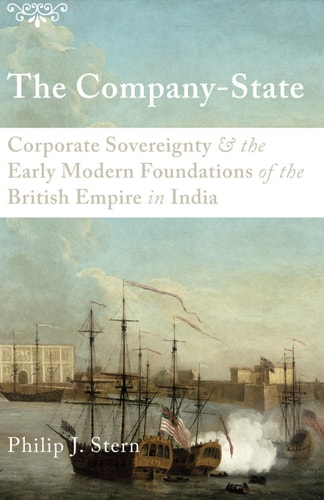
The Company-State: Corporate Sovereignty and the Early Modern Foundations of the British Empire in India
0
0
As an Amazon Associate and affiliate partner, Menrva Books earns from qualifying purchases. Learn more
Author Description
Almost since the event itself in 1757, the English East India Company's victory over the forces of the nawab of Bengal and the territorial acquisitions that followed has been perceived as the moment when the British Empire in India was born. Examining the Company's political and intellectual history in the century prior to this supposed transformation, The Company-State rethinks this narrative and the nature of the early East India Company itself. In this book, Philip J. Stern reveals the history of a corporation concerned not simply with the bottom line but also with the science of colonial governance. Stern demonstrates how Company leadership wrestled with typical early modern problems of political authority, such as the mutual obligations of subjects and rulers; the relationships among law, economy, and sound civil and colonial society; the constitution of civic institutions ranging from tax collection and religious practice to diplomacy and warmaking; and the nature of jurisdiction and sovereignty over people, territory, and the sea. Their ideas emerged from abstract ideological, historical, and philosophical principles and from the real-world entanglements of East India Company employees and governors with a host of allies, rivals, and polyglot populations in their overseas plantations. As the Company shaped this colonial polity, it also confronted shifting definitions of state and sovereignty across Eurasia that ultimately laid the groundwork for the Company's incorporation into the British empire and state through the eighteenth century.Challenging traditional distinctions between the commercial and imperial eras in British India, as well as a colonial Atlantic world and a "trading world" of Asia, The Company-State offers a unique perspective on the fragmented nature of state, sovereignty, and empire in the early modern world.
Menrva's Summary
THE THESIS
This book investigates how the English East India Company functioned as a sovereign political entity rather than merely a commercial enterprise during the century preceding its formal territorial expansion in India. Philip J. Stern, a historian of the British Empire, utilizes extensive archival research to challenge the traditional binary between trade and governance. He argues that the Company developed complex systems of law, diplomacy, and civic administration that mirrored state-level functions, effectively operating as a 'company-state' long before its integration into the formal British imperial structure.
THE SCOPE MAP
What You Will Find
- Analysis of early modern political theory regarding sovereignty and corporate authority.
- Examination of the East India Company's administrative practices in tax collection, religious regulation, and warmaking.
- Case studies of interactions between Company officials and diverse Eurasian populations.
- A re-evaluation of the transition from commercial trading entity to colonial governing body.
THE AUTHORITY PERSPECTIVE
Scholars in the field of imperial history recognize this work as a significant revisionist text that complicates the understanding of early modern statehood. Readers frequently note the academic density of the prose and the rigorous archival methodology employed to support the author's central arguments.
Page Count:
318
Publication Date:
2011-01-01
Publisher:
Oxford University Press
ISBN-10:
0199889449
ISBN-13:
9780199889440
History
Colonialism
European History
East India Company
Corporations india
Economic History
Asian History
British Empire
India
Community Tags
Similar Books