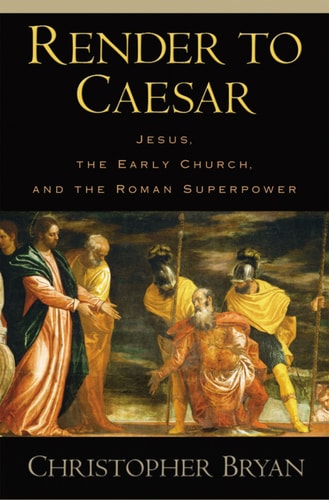
Render to Caesar: Jesus, the Early Church, and the Roman Superpower
0
0
As an Amazon Associate and affiliate partner, Menrva Books earns from qualifying purchases. Learn more
Author Description
At the end of the 20th century, "postcolonialism" described the effort to understand the experience of those who had lived under colonial rule. This kind of thinking has inevitably brought about a reexamination of the rise of Christianity, which took place under Roman colonial rule. How did Rome look from the viewpoint of an ordinary Galilean in the first century of the Christian era? What should this mean for our own understanding of and relationship to Jesus of Nazareth? In the past, Jesus was often "depoliticized," treated as a religious teacher imparting timeless truths for all people. Now, however, many scholars see Jesus as a political leader whose goal was independence from Roman rule so that the people could renew their traditional way of life under the rule of God. In Render to Caesar, Christopher Bryan reexamines the attitude of the early Church toward imperial Rome. Choosing a middle road, he asserts that Jesus and the early Christians did indeed have a critique of the Roman superpower -- a critique that was broadly in line with the entire biblical and prophetic tradition. One cannot worship the biblical God, the God of Israel, he argues, and not be concerned about justice in the here and now. On the other hand, the biblical tradition does not challenge human power structures by attempting to dismantle them or replace them with other power structures. Instead, Jesus' message consistently confronts such structures with the truth about their origin and purpose. Their origin is that God permits them. Their purpose is to promote God's peace and justice. Power is understood as a gift from God, a gift that it is to be used to serve God's will and a gift that can be taken away by God when misused. Render to Caesar transforms our understanding of early Christians and their relationship to Rome and demonstrates how Jesus' teaching continues to challenge those who live under structures of government quite different from those that would have been envisaged by the a
Menrva's Summary
THE THESIS
This book investigates how the early Christian movement navigated its existence under the authority of the Roman Empire and whether Jesus of Nazareth presented a political challenge to imperial power. Christopher Bryan, a scholar of the New Testament, utilizes historical context and biblical exegesis to argue that while early Christians maintained a critique of Roman power, they did not seek to dismantle or replace political structures. Instead, he posits that the biblical tradition frames human authority as a conditional gift from God, intended to serve justice rather than absolute dominion.
THE SCOPE MAP
What You Will Find
- Historical analysis of the first-century Roman colonial environment in Galilee.
- Exegesis of New Testament passages concerning Jesus and his interaction with imperial authority.
- A comparative study of biblical prophetic traditions and their application to political power.
- A theological framework for understanding the relationship between divine sovereignty and human governance.
THE AUTHORITY PERSPECTIVE
Scholars and theologians frequently cite this work as a nuanced contribution to the study of political theology in the ancient world. Readers note that the text provides a balanced perspective that avoids the extremes of both purely spiritualized and purely revolutionary interpretations of the Gospels.
Page Count:
197
Publication Date:
2005-01-01
Publisher:
Oxford University Press
ISBN-10:
019988479X
ISBN-13:
9780199884797
Religion
History
Christianity
Theology
Ancient History
Jesus Christ
Bibles
Church & State
Community Tags
Similar Books