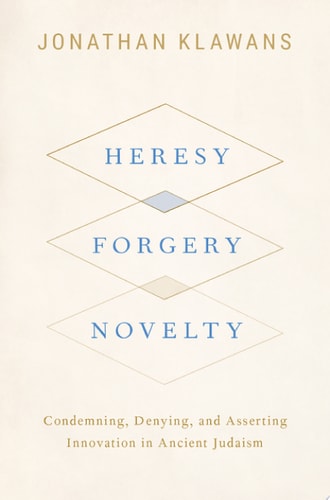
Heresy, Forgery, Novelty: Condemning, Denying, and Asserting Innovation in Ancient Judaism
0
0
As an Amazon Associate and affiliate partner, Menrva Books earns from qualifying purchases. Learn more
Author Description
It is commonly asserted that heresy is a Christian invention that emerged in late antiquity as Christianity distinguished itself from Judaism. Heresy, Forgery, Novelty probes ancient Jewish disputes regarding religious innovation and argues that Christianity's heresiological impulse is in fact indebted to Jewish precedents.In this book, Jonathan Klawans demonstrates that ancient Jewish literature displays a profound unease regarding religious innovation. The historian Josephus condemned religious innovation outright, and later rabbis valorize the antiquity of their traditions. The Dead Sea sectarians spoke occasionally-and perhaps secretly-of a "new covenant," but more frequently masked newer ideas in rhetorics of renewal or recovery. Other ancient Jews engaged in pseudepigraphy-the false attribution of recent works to prophets of old. The flourishing of such religious forgeries further underscores the dangers associated with religious innovation.As Christianity emerged, the discourse surrounding religious novelty shifted dramatically. On the one hand, Christians came to believe that Jesus had inaugurated a "new covenant," replacing what came prior. On the other hand, Christian writers followed their Jewish predecessors in condemning heretics as dangerous innovators, and concealing new works in pseudepigraphic garb. In its open, unabashed embrace of new things, Christianity parts from Judaism. Christianity's heresiological condemnation of novelty, however, displays continuity with prior Jewish traditions. Heresy, Forgery, Novelty reconsiders and offers a new interpretation of the dynamics of the split between Judaism and Christianity.
Menrva's Summary
THE THESIS
This book investigates the origins of heresiological discourse by examining how ancient Jewish traditions navigated the tension between religious innovation and the preservation of antiquity. Jonathan Klawans, a scholar of ancient Judaism, utilizes a wide array of primary sources—including the works of Josephus, Dead Sea Scrolls, and rabbinic literature—to argue that the Christian concept of heresy is deeply rooted in earlier Jewish anxieties regarding novelty. He posits that while Christianity eventually embraced the concept of a 'new covenant,' it simultaneously inherited and adapted Jewish rhetorical strategies for condemning innovation and utilizing pseudepigraphy.
THE SCOPE MAP
What You Will Find
- Analysis of religious innovation in the works of Josephus and early rabbinic texts.
- Examination of the rhetoric of 'renewal' versus 'newness' within the Dead Sea Scrolls.
- Investigation into the practice of pseudepigraphy as a method for legitimizing new religious ideas.
- Comparative study of Jewish and Christian attitudes toward tradition and change.
Scope Limits
- The text does not provide an exhaustive history of early Christian theology.
- It does not focus on modern or medieval developments of heresy beyond the foundational ancient period.
THE AUTHORITY PERSPECTIVE
Scholars and historians of religion frequently cite this work for its nuanced re-evaluation of the historical split between Judaism and Christianity. Readers often note the academic rigor and the clarity with which Klawans connects disparate ancient texts to form a cohesive argument about religious identity.
Page Count:
240
Publication Date:
2019-10-01
Publisher:
Oxford University Press
ISBN-10:
0190062509
ISBN-13:
9780190062507
History
Religion
Soft Sci-fi
Christianity
Judaism
Theology
Church History
Social Sciences - Religion - Christianity
New Used & Rental Textbooks
Sacred Writings
Ancient History
Church Leadership
Community Tags
Other Editions(2)
Similar Books