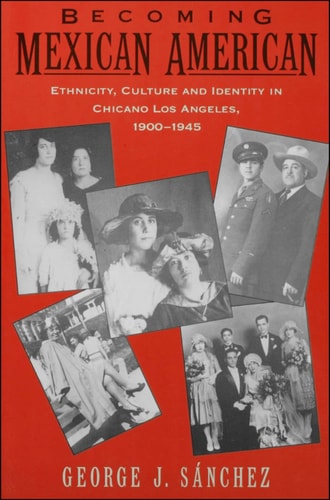
Becoming Mexican American: Ethnicity, Culture, and Identity in Chicano Los Angeles, 1900-1945
0
0
As an Amazon Associate and affiliate partner, Menrva Books earns from qualifying purchases. Learn more
Author Description
Twentieth-century Los Angeles has been the locus of one of the most profound and complex interactions between variant cultures in American history. Yet this study is among the first to examine the relationship between ethnicity and identity among the largest immigrant group to that city. By focusing on Mexican immigrants to Los Angeles from 1900 to 1945, George J. Sánchez explores the process by which temporary sojourners altered their orientation to that of permanent residents, thereby laying the foundation for a new Mexican-American culture. Analyzing not only formal programs aimed at these newcomers by the United States and Mexico, but also the world created by these immigrants through family networks, religious practice, musical entertainment, and work and consumption patterns, Sánchez uncovers the creative ways Mexicans adapted their culture to life in the United States. When a formal repatriation campaign pushed thousands to return to Mexico, those remaining in Los Angeles launched new campaigns to gain civil rights as ethnic Americans through labor unions and New Deal politics. The immigrant generation, therefore, laid the groundwork for the emerging Mexican-American identity of their children.
Menrva's Summary
THE THESIS
How did Mexican immigrants in early twentieth-century Los Angeles transition from temporary laborers to a permanent, distinct ethnic community? George J. Sánchez, a professor of American Studies and Ethnicity, utilizes a wide array of primary sources—including government records, labor union archives, and oral histories—to document the evolution of Mexican-American identity. He argues that this transformation was not merely a result of assimilation, but a proactive, creative synthesis of traditional Mexican values and the realities of life in the United States. By examining the period between 1900 and 1945, the author demonstrates how family networks, religious institutions, and political activism forged a new cultural consciousness.
THE SCOPE MAP
What You Will Find
- Analysis of the socio-economic impact of the Mexican Revolution and subsequent migration patterns to Los Angeles.
- Examination of institutional efforts to Americanize immigrants through government programs and religious outreach.
- Detailed study of the 1930s repatriation campaigns and their effect on community stability and political mobilization.
- Exploration of the role of labor unions and New Deal politics in the development of civil rights advocacy among Mexican-Americans.
THE AUTHORITY PERSPECTIVE
Historians and sociologists frequently cite this work as a foundational text for understanding the development of ethnic identity in urban American environments. Experts highlight the author's meticulous use of archival research to bridge the gap between individual immigrant experiences and broader structural shifts in the American West.
Page Count:
402
Publication Date:
1995-01-01
Publisher:
Oxford University Press
ISBN-10:
0199880034
ISBN-13:
9780199880034
History
American History
Sociology
Minority Studies
Ethnic Studies
Immigration
Los Angeles