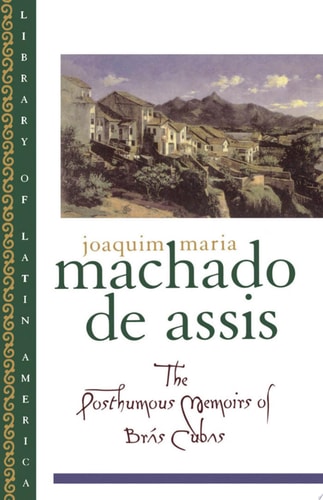
The Posthumous Memoirs of Brás Cubas
0
0
As an Amazon Associate and affiliate partner, Menrva Books earns from qualifying purchases. Learn more
Author Description
Be aware that frankness is the prime virtue of a dead man," writes the narrator of The Posthumous Memoirs of Brás Cubas. But while he may be dead, he is surely one of the liveliest characters in fiction, a product of one of the most remarkable imaginations in all of literature, Brazil's greatest novelist of the nineteenth century, Joaquim Maria Machado de Assis.By turns flippant and profound, The Posthumous Memoirs of Brás Cubas is the story of an unheroic man with half-hearted political ambitions, a harebrained idea for curing the world of melancholy, and a thousand quixotic theories unleashed from beyond the grave. It is a novel that has influenced generations of Latin American writers but remains refreshingly and unforgettably unlike anything written before or after it. Newly translated by Gregory Rabassa and superbly edited by Enylton de Sá Rego and Gilberto Pinheiro Passos, this Library of Latin America edition brings to English-speaking readers a literary delight of the highest order.
Menrva's Summary
THE PULSE
A deceased narrator recounts his life story from beyond the grave, offering a cynical and detached perspective on his own failures and the society he inhabited. Brás Cubas, a man of modest achievements and unfulfilled ambitions, narrates his existence with a biting, self-aware wit that challenges traditional biographical conventions. He navigates the social hierarchies of nineteenth-century Brazil, driven by vanity and a desire for legacy, while constantly undermining his own importance. The narrative framework is strictly first-person and non-linear, allowing the protagonist to jump between childhood memories, adult disappointments, and his current state of post-mortem reflection.
INSIDE THE PAGES
- Unreliable first-person narration from a deceased protagonist
- Non-linear structure that defies chronological progression
- Satirical commentary on the social and political landscape of 19th-century Brazil
- Philosophical digressions on human nature and vanity
- Meta-fictional addresses to the reader
- Use of irony to deflate the protagonist's self-importance
- Episodic chapters that vary significantly in length and tone
- Exploration of themes regarding legacy and the futility of ambition
THE COLLECTIVE ECHO
Readers and critics frequently highlight the novel's innovative structure and the narrator's sharp, sardonic voice as defining characteristics of the work. Discussion often centers on how Machado de Assis uses the protagonist's death to provide a unique vantage point for social critique and philosophical inquiry. Many observers note the balance between the protagonist's personal failures and the broader, often biting, observations about the human condition. The text is widely recognized for its influence on Latin American literature and its ability to remain distinct from contemporary realist works of the period. Readers often find the narrative style both challenging and rewarding due to its playful subversion of traditional storytelling expectations.
Page Count:
235
Publication Date:
1998-01-01
Publisher:
Oxford University Press
ISBN-10:
0199880239
ISBN-13:
9780199880232
Satire
Latin American
classic
English & College Success
Philosophical
English
Realism