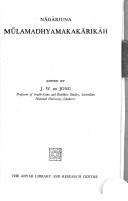
Mūlamadhyamakakārikāḥ
0
0
As an Amazon Associate and affiliate partner, Menrva Books earns from qualifying purchases. Learn more
Author Description
Verse work on the basic tenets of the Mādhyamika school in Buddhist philosophy.
Menrva's Summary
THE THESIS
The Mūlamadhyamakakārikāḥ (MMK) presents a rigorous philosophical inquiry into the nature of reality, challenging conventional understandings of existence. Nagarjuna, a pivotal figure in Mahayana Buddhism, systematically deconstructs concepts such as causality, motion, and identity through a dialectical method known as prasanga. He argues that all phenomena are empty of inherent existence (svabhāva), meaning they arise dependently and lack independent self-nature. This emptiness is not a nihilistic void but the very condition that allows for change, interaction, and liberation from suffering.
THE SCOPE MAP
- Verse work on the basic tenets of the Mādhyamika school in Buddhist philosophy.
- Systematic deconstruction of concepts like causality, motion, and identity.
- Argument for the emptiness (śūnyatā) of all phenomena.
- Exploration of dependent origination (pratītyasamutpāda) as the basis of reality.
- Dialectical method (prasanga) to refute inherent existence.
- Foundational text for Mahayana Buddhist philosophy.
THE AUTHORITY PERSPECTIVE
The Mūlamadhyamakakārikāḥ is universally recognized as a foundational text in Mahayana Buddhist philosophy, particularly for the Madhyamaka school. Scholars and practitioners alike have engaged with Nagarjuna's profound arguments on emptiness and dependent origination for centuries. Its rigorous dialectical approach and radical critique of inherent existence have made it a subject of extensive commentary and debate within Buddhist traditions and in comparative philosophy. The text's enduring influence underscores its significance in shaping Buddhist thought and its continued relevance for understanding the nature of reality.
Page Count:
57
Publication Date:
1977-01-01
ISBN-10:
0835675319
Non-Fiction
Philosophy
Religion
Buddhism
Community Tags
Similar Books