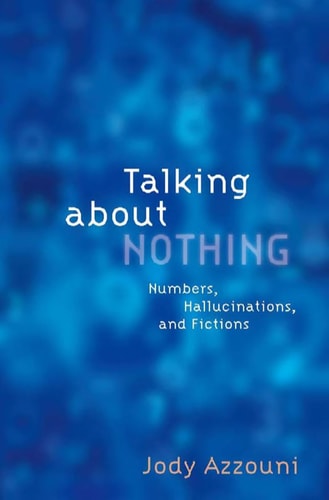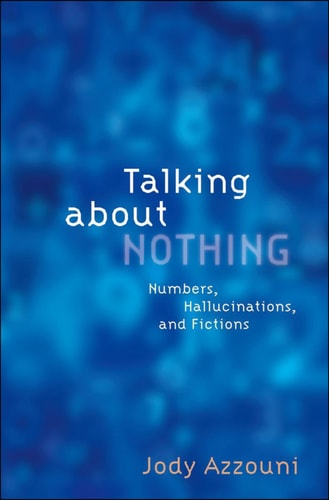
Talking About Nothing: Numbers, Hallucinations, and Fictions
0
0
As an Amazon Associate and affiliate partner, Menrva Books earns from qualifying purchases. Learn more
Author Description
Ordinary language and scientific language enable us to speak about, in a singular way (using demonstratives and names), what we recognize not to exist: fictions, the contents of our hallucinations, abstract objects, and various idealized but nonexistent objects that our scientific theories are often couched in terms of. Indeed, references to such nonexistent items-especially in the case of the application of mathematics to the sciences-are indispensable. We cannot avoid talking about such things. Scientific and ordinary languages thus enable us to say things about Pegasus or about hallucinated objects that are true (or false), such as "Pegasus was believed by the ancient Greeks to be a flying horse," or "That elf I'm now hallucinating over there is wearing blue shoes." Standard contemporary metaphysical views and semantic analyses of singular idioms on offer in contemporary philosophy of language have not successfully accommodated these routine practices of saying true and false things about the nonexistent while simultaneously honoring the insight that such things do not exist in any way at all (and have no properties). That is, philosophers often feel driven to claim that such objects do exist, or they claim that all our talk isn't genuine truth-apt talk, but only pretence. This book reconfigures metaphysics (and the role of metaphysics in semantics) in radical ways that allow the accommodation of our ordinary ways of speaking of what does not exist while retaining the absolutely crucial presupposition that such objects exist in no way at all, have no properties, and so are not the truth-makers for the truths and falsities that are about them.
Menrva's Summary
THE THESIS
This book investigates the philosophical paradox of how ordinary and scientific language allows for meaningful, truth-apt discourse regarding objects that do not exist. Jody Azzouni, a professor of philosophy, challenges standard metaphysical and semantic frameworks that struggle to reconcile the existence of true statements about non-existent entities like abstract objects or fictions. He proposes a reconfiguration of metaphysics that permits such discourse without granting ontological status or properties to these non-existent items.
THE SCOPE MAP
What You Will Find
- Analysis of singular idioms and demonstratives in both common and scientific language.
- A critique of contemporary metaphysical views regarding truth-aptness and reference.
- Examination of the role of abstract objects and idealized entities in mathematical and scientific theories.
- A proposed framework for maintaining ontological commitment to non-existence while validating truth-claims about fictions and hallucinations.
THE AUTHORITY PERSPECTIVE
Experts in the field of analytic philosophy recognize this work as a significant contribution to the ongoing debate surrounding ontological commitment and semantic reference. Readers frequently note the technical density of the prose, which requires a strong background in contemporary philosophy of language to fully grasp the author's arguments.
Page Count:
282
Publication Date:
2010-01-01
Publisher:
Oxford University Press
ISBN-10:
019989003X
ISBN-13:
9780199890033
Philosophy
English & College Success
English
Logic
Metaphysics
Epistemology
Linguistics