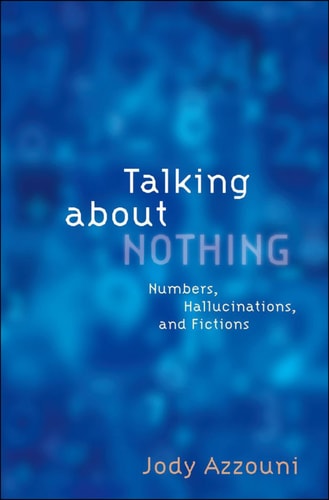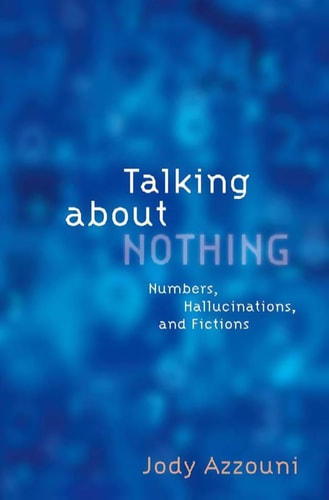
Talking about Nothing: Numbers, Hallucinations, and Fictions
0
0
As an Amazon Associate and affiliate partner, Menrva Books earns from qualifying purchases. Learn more
Author Description
Ordinary language and scientific language enable us to speak about, in a singular way (using demonstratives and names), what we recognize not to exist: fictions, the contents of our hallucinations, abstract objects, and various idealized but nonexistent objects that our scientific theories are often couched in terms of. Indeed, references to such nonexistent items-especially in the case of the application of mathematics to the sciences-are indispensable. We cannot avoid talking about such things. Scientific and ordinary languages thus enable us to say things about Pegasus or about hallucinated objects that are true (or false), such as "Pegasus was believed by the ancient Greeks to be a flying horse," or "That elf I'm now hallucinating over there is wearing blue shoes." Standard contemporary metaphysical views and semantic analyses of singular idioms on offer in contemporary philosophy of language have not successfully accommodated these routine practices of saying true and false things about the nonexistent while simultaneously honoring the insight that such things do not exist in any way at all (and have no properties). That is, philosophers often feel driven to claim that such objects do exist, or they claim that all our talk isn't genuine truth-apt talk, but only pretence. This book reconfigures metaphysics (and the role of metaphysics in semantics) in radical ways that allow the accommodation of our ordinary ways of speaking of what does not exist while retaining the absolutely crucial presupposition that such objects exist in no way at all, have no properties, and so are not the truth-makers for the truths and falsities that are about them.
Menrva's Summary
THE THESIS
This book investigates the philosophical paradox of how ordinary and scientific language allows us to make true or false statements about objects that do not exist. Jody Azzouni, a professor of philosophy, challenges contemporary metaphysical and semantic frameworks that struggle to reconcile the existence of discourse about non-existent entities with the ontological reality that such objects possess no properties and do not exist. He proposes a reconfigured metaphysical approach that validates our routine linguistic practices without granting ontological status to fictions, hallucinations, or abstract objects.
THE SCOPE MAP
What You Will Find
- Analysis of singular idioms and demonstratives in ordinary and scientific language
- A critique of current semantic theories regarding truth-aptness and non-existent objects
- Examination of the role of mathematics and idealized objects in scientific theory
- A proposed metaphysical framework that separates discourse from ontological commitment
THE AUTHORITY PERSPECTIVE
Philosophers and scholars of language recognize this work as a rigorous intervention in the debate over ontological commitment and semantic truth. Readers frequently note the technical density of the prose, which requires a strong background in analytic philosophy to fully navigate the author's arguments.
Page Count:
288
Publication Date:
2010-09-30
Publisher:
Oxford University Press
ISBN-10:
0199738947
ISBN-13:
9780199738946
Philosophy
Metaphysics
Ontology
Logic
Epistemology