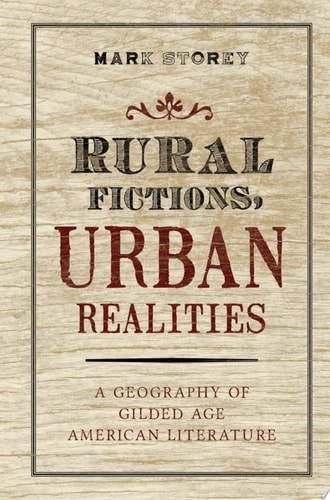
Rural Fictions, Urban Realities: A Geography of Gilded Age American Literature
0
0
As an Amazon Associate and affiliate partner, Menrva Books earns from qualifying purchases. Learn more
Author Description
The diminishment of rural life at the hands of urbanization, for many, defines the years between the end of the Civil War and the dawn of the twentieth century in the U.S. Traditional literary histories find this transformation clearly demarcated between rural tales-stories set in the countryside, marked by attention to regional dialect and close-knit communities-and grittier novels and short stories that reflected the harsh realities of America's growing cities. Challenging this conventional division, Mark Storey proffers a capacious, trans-regional version of rural fiction that contains and coexists with urban-industrial modernity.To remap literary representations of the rural, Storey pinpoints four key aspects of everyday life that recur with surprising frequency in late nineteenth-century fiction: train journeys, travelling circuses, country doctors, and lynch mobs. Fiction by figures such as Hamlin Garland, Booth Tarkington, and William Dean Howells use railroads and roving carnivals to signify the deeper incursions of urban capitalism into the American countryside. A similar, somewhat disruptive migration of the urban into the rural occurs with the arrival of modern medicine, as viewed in depictions of the country doctor in novels like Sarah Orne Jewett's A Country Doctor and Harold Frederic's The Damnation of Theron Ware. This discussion gives way to a far darker interaction between the urban and the rural, with the intricate relationship of vigilante justice to an emerging modernity used to frame readings of rural lynchings in works by writers like Bret Harte, Charles Chesnutt, Paul Laurence Dunbar, and Owen Wister. The four arenas-transport, entertainment, medicine, and the law-used to organize the study come together in a coda devoted to utopian fiction, which demonstrates one of the more imaginative methods used to express the social and literary anxieties around the changing nature of urban and rural space at the end of the nineteenth century.
Menrva's Summary
THE THESIS
Does the conventional binary between rural and urban settings in Gilded Age American literature accurately reflect the complex socio-economic transformations of the era? Mark Storey, a scholar of American literature, challenges the traditional demarcation between pastoral regionalism and urban realism by examining how industrial modernity permeated the countryside. He argues that rural fiction of the late nineteenth century was not an isolated genre but a space where urban capitalism, technology, and social anxieties were actively negotiated and integrated.
THE SCOPE MAP
What You Will Find
- Analysis of late nineteenth-century American literature spanning the post-Civil War era to the early twentieth century.
- A thematic framework organized around four key arenas: train travel, traveling circuses, country doctors, and lynch mobs.
- Examination of works by authors including Hamlin Garland, Booth Tarkington, William Dean Howells, Sarah Orne Jewett, and Charles Chesnutt.
- A concluding study on utopian fiction as a vehicle for expressing anxieties regarding the shifting urban-rural landscape.
THE AUTHORITY PERSPECTIVE
Scholars and critics recognize this work as a significant re-evaluation of the regionalist and realist traditions in American letters. Readers frequently note the academic density of the prose, which provides a rigorous, interdisciplinary approach to understanding the spatial politics of the Gilded Age.
Page Count:
208
Publication Date:
2013-01-17
Publisher:
Oxford University Press
ISBN-10:
0199893187
ISBN-13:
9780199893188
History
Geography
Literary Criticism
American
In literature
Community Tags
Similar Books