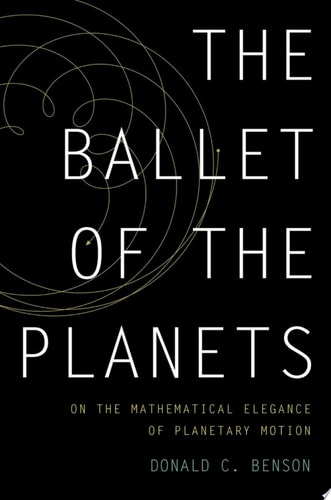
Ballet of the Planets: A Mathematician's Musings on the Elegance of Planetary Motion
0
0
As an Amazon Associate and affiliate partner, Menrva Books earns from qualifying purchases. Learn more
Author Description
The Ballet Of The Planets Unravels The Beautiful Mystery Of Planetary Motion, Revealing How Our Understanding Of Astronomy Evolved From Archimedes And Ptolemy To Copernicus, Kepler, And Newton. Mathematician Donald Benson Shows That Ancient Theories Of Planetary Motion Were Based On The Assumptions That The Earth Was The Center Of The Universe And The Planets Moved In A Uniform Circular Motion. Since Ancient Astronomers Noted That Occasionally A Planet Would Exhibit Retrograde Motion--would Seem To Reverse Its Direction And Move Briefly Westward--they Concluded That The Planets Moved In Epicyclic Curves, Circles With Smaller Interior Loops, Similar To The Patterns Of A Child's Spirograph. With The Coming Of The Copernican Revolution, The Retrograde Motion Was Seen To Be Apparent Rather Than Real, Leading To The Idea That The Planets Moved In Ellipses. This Laid The Ground For Newton's Great Achievement--integrating The Concepts Of Astronomy And Mechanics--which Revealed Not Only How The Planets Moved, But Also Why. Throughout, Benson Focuses On Naked-eye Astronomy, Which Makes It Easy For The Novice To Grasp The Work Of These Pioneers Of Astronomy.
Menrva's Summary
THE THESIS
This book investigates the historical and mathematical evolution of planetary motion theories, tracing the transition from ancient geocentric models to the Newtonian synthesis. Mathematician Donald C. Benson examines how early astronomers accounted for complex planetary movements through geometric constructs like epicycles. By focusing on naked-eye observations, the author bridges the gap between ancient observational challenges and the eventual development of modern celestial mechanics. The text argues that the elegance of planetary motion is best understood through the progression of mathematical models that define our solar system.
THE SCOPE MAP
What You Will Find
- Historical analysis of planetary motion theories from Archimedes and Ptolemy to Copernicus, Kepler, and Newton.
- Mathematical explanations of epicyclic curves and their role in early astronomical models.
- Examination of the Copernican Revolution and the shift from circular motion to elliptical orbits.
- Integration of astronomical observation with Newtonian mechanics to explain the 'why' behind planetary movement.
THE AUTHORITY PERSPECTIVE
Experts and readers alike appreciate this work for its accessible approach to complex astronomical history. The text is frequently cited as a valuable resource for novices seeking to understand the mathematical foundations of celestial mechanics without requiring advanced technical training.
Page Count:
256
Publication Date:
2012-01-01
Publisher:
Oxford University Press, Incorporated
ISBN-10:
019989101X
ISBN-13:
9780199891016
Science
Physics
Astronomy
Mathematics
Community Tags
Similar Books