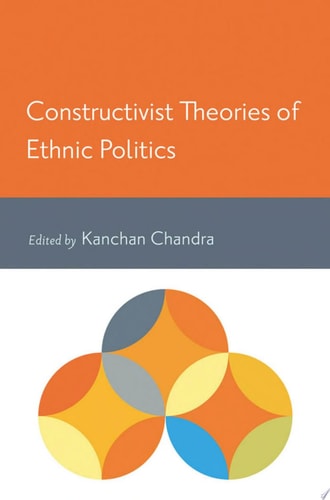
Constructivist Theories of Ethnic Politics
0
0
As an Amazon Associate and affiliate partner, Menrva Books earns from qualifying purchases. Learn more
Author Description
Most research on the effect of ethnicity on economic and political outcomes is driven by the "primordialist" assumption that ethnic identities are fixed. But "constructivist" research across the social sciences and humanities tells us that ethnic identities change over time, and are often a product of the very political and economic phenomena that they are used to explain.Constructivist Theories of Ethnic Politics is a first cut at rebuilding theories of the relationship between ethnicity, politics and economics on a fortified constructivist foundation. It proposes a new conceptual framework for thinking about ethnic identity. It uses this framework to synthesize constructivist arguments into a set of propositions about how and why ethnic identities change. It translates this framework - and the propositions derived from it -- into a new, combinatorial language. And it employs these conceptual, constructivist, and combinatorial tools to theorize about the relationship between ethnicity, politics and economics using a variety of methods.The conceptual tools provided here open new avenues for theory building by representing the complexity of a constructivist world in an analytically tractable way. The theoretical arguments challenge the bad name that ethnic diversity has acquired in social scientific literature, according to which it is associated with regimes that are less stable, less democratic, less well-governed, less peaceful and poorer than regimes in which the population is ethnically homogeneous. Taking the possibility of change in ethnic identity into account, this book shows, dismantles the theoretical logics linking ethnic diversity to such negative outcomes. Indeed, ethnic diversity can sometimes serve as a benign force, strengthening rather than threatening democracy, preventing rather than producing violence, and inhibiting rather than accelerating state collapse or secession. Even more importantly, it defines new research agendas by changing the questi
Menrva's Summary
THE THESIS
This book investigates how the assumption that ethnic identities are fluid, rather than fixed, necessitates a complete reconstruction of existing theories regarding the relationship between ethnicity, politics, and economics. Kanchan Chandra, a scholar in political science, challenges the prevailing primordialist paradigm by proposing a new conceptual framework that treats ethnic identity as a variable product of political and economic phenomena. By synthesizing constructivist arguments into a combinatorial language, the author provides a rigorous methodology for analyzing how and why these identities shift over time.
THE SCOPE MAP
What You Will Find
- A new conceptual framework for modeling ethnic identity as a dynamic, rather than static, variable.
- A combinatorial language designed to translate constructivist propositions into analytically tractable models.
- A critical re-evaluation of the link between ethnic diversity and negative political outcomes such as instability and poor governance.
- Theoretical arguments demonstrating how ethnic diversity can function as a stabilizing force for democracy and peace.
THE AUTHORITY PERSPECTIVE
Experts recognize this work as a significant contribution to the field of political science for its attempt to formalize constructivist theory. Readers frequently note the high level of analytical rigor and the density of the theoretical framework presented throughout the text.
Page Count:
520
Publication Date:
2012-10-02
Publisher:
Oxford University Press
ISBN-10:
0199893152
ISBN-13:
9780199893157
Political Theory
Ethnic Groups
Cultural Anthropology
International relations
Ethnic Studies
Ethnicity
Ethnic relations
Sociology
Comparative Politics
Community Tags
Other Editions(4)

Similar Books



Reader Comments
Share Your Thoughts
No comments yet. Be the first to share your thoughts!