
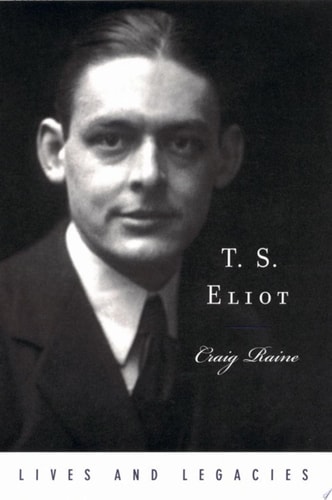
T. S. Eliot
0
0
As an Amazon Associate and affiliate partner, Menrva Books earns from qualifying purchases. Learn more
Author Description
The winner of the Nobel Prize for Literature, the twentieth century's most famous poet and its most influential literary arbiter, T.S. Eliot has long been thought to be an obscure and difficult poet--forbiddingly learned, maddeningly enigmatic. Now, in this brilliant exploration of T.S. Eliot's work, prize-winning poet Craig Raine reveals that, on the contrary, Eliot's poetry (and drama and criticism) can be seen as a unified and coherent body of work. Indeed, despite its manifest originality, its radical experimentation, and its dazzling formal variety, his verse yields meaning just as surely as other more conventional poetry. Raine argues that an implicit controlling theme--the buried life, or the failure of feeling--unfolds in surprisingly varied ways throughout Eliot's work. But alongside Eliot's desire "to live with all intensity" was also a distrust of "violent emotion for its own sake." Raine illuminates this paradoxical Eliot--an exacting anti-romantic realist, skeptical of the emotions, yet incessantly troubled by the fear of emotional failure--through close readings of such poems as "The Love Song of J Alfred Prufrock," "Gerontion," The Hollow Men, Ash Wednesday, and many others. The heart of the book contains extended analyses of Eliot's two master works--The Waste Land and Four Quartets. Raine also examines Eliot's criticism--including his coinage of such key literary terms as the objective correlative, dissociation of sensibility, the auditory imagination--and he concludes with a convincing refutation of charges that Eliot was an anti-Semite. Here then is a volume absolutely indispensable for all admirers of T.S. Eliot and, in fact, for everyone who loves modern literature.
Menrva's Summary
THE THESIS
This book investigates whether the work of T.S. Eliot, often perceived as fragmented and enigmatic, possesses a unified and coherent thematic core. Craig Raine, a prize-winning poet himself, utilizes his deep familiarity with poetic craft to challenge the notion that Eliot’s verse is inaccessible. By examining the tension between Eliot’s desire for intense experience and his skepticism toward unchecked emotion, Raine argues that a consistent preoccupation with the 'buried life' and the failure of feeling provides a structural key to understanding the poet's entire output.
THE SCOPE MAP
What You Will Find
- Close readings of major poetic works including The Waste Land, Four Quartets, and The Love Song of J. Alfred Prufrock.
- Analysis of Eliot’s critical terminology, such as the objective correlative and dissociation of sensibility.
- A critical examination of the biographical and historical charges of anti-Semitism leveled against Eliot.
- A thematic framework connecting Eliot’s drama, criticism, and poetry into a singular, coherent body of work.
THE AUTHORITY PERSPECTIVE
Critics and scholars frequently note that Raine’s perspective is uniquely informed by his own background as a practicing poet, which allows for a more technical appreciation of Eliot’s formal innovations. The text is widely regarded as a valuable resource for those seeking to bridge the gap between Eliot’s reputation for difficulty and the actual accessibility of his thematic concerns.
Page Count:
224
Publication Date:
2011-01-01
Publisher:
Oxford University Press
ISBN-10:
0199910421
ISBN-13:
9780199910427
Biography
Poetry
English & College Success
Modernism
Biography Autobiography
English
Literary Criticism
Literary History
Poets biography
Critics
Community Tags
Other Editions(3)

Similar Books


Reader Comments
Share Your Thoughts
No comments yet. Be the first to share your thoughts!