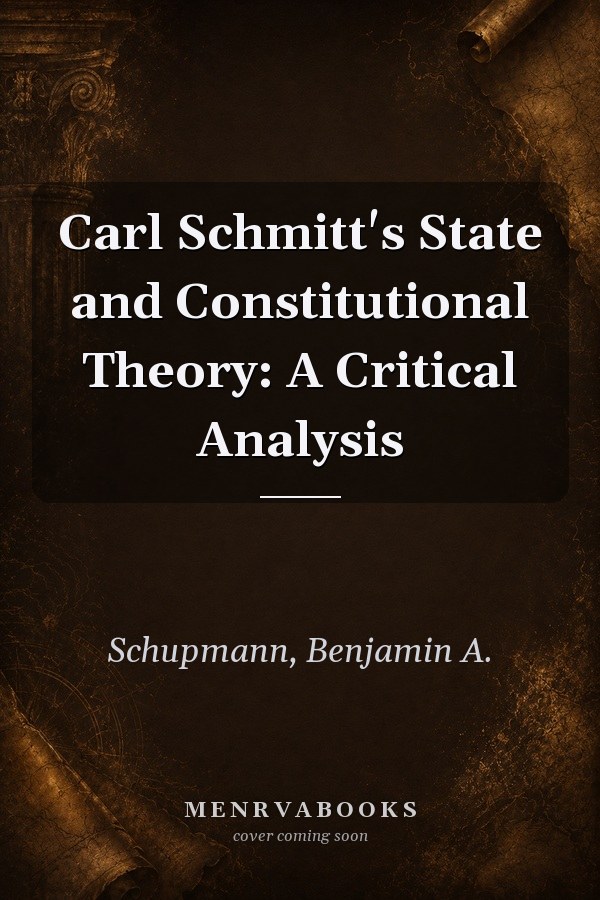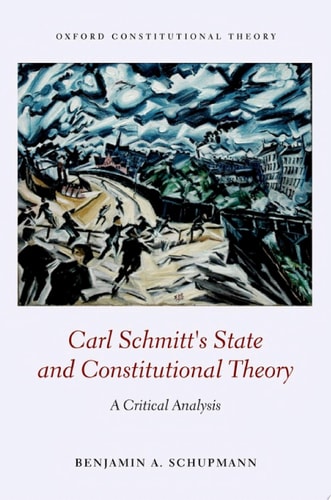
Carl Schmitt's State and Constitutional Theory: A Critical Analysis
0
0
As an Amazon Associate and affiliate partner, Menrva Books earns from qualifying purchases. Learn more
Author Description
Can a constitutional democracy commit suicide? Can an illiberal antidemocratic party legitimately obtain power through democratic elections and amend liberalism and democracy out of the constitution entirely? In Weimar Germany, these theoretical questions were both practically and existentially relevant. By 1932, the Nazi and Communist parties combined held a majority of seats in parliament. Neither accepted the legitimacy of liberal democracy. Their only reason for participating democratically was to amend the constitution out of existence. This book analyses Carl Schmitt's state and constitutional theory and shows how it was conceived in response to the Weimar crisis. Right-wing and left-wing political extremists recognized that a path to legal revolution lay in the Weimar constitution's combination of democratic procedures, total neutrality toward political goals, and positive law. Schmitt's writings sought to address the unique problems posed by mass democracy. Schmitt's thought anticipated 'constrained' or 'militant' democracy, a type of constitution that guards against subversive expressions of popular sovereignty and whose mechanisms include the entrenchment of basic constitutional commitments and party bans. Schmitt's state and constitutional theory remains important: the problems he identified continue to exist within liberal democratic states. Schmitt offers democrats today a novel way to understand the legitimacy of liberal democracy and the limits of constitutional change.
Menrva's Summary
THE THESIS
This book investigates whether a constitutional democracy can protect itself from being dismantled by antidemocratic forces operating within its own legal framework. Benjamin A. Schupmann, a scholar of political theory, utilizes the historical context of the Weimar Republic to examine the constitutional crisis of 1932. He argues that Carl Schmitt's work provides a critical framework for understanding the vulnerabilities of liberal democracy and the necessity of 'militant' constitutional mechanisms to preserve democratic integrity.
THE SCOPE MAP
What You Will Find
- Analysis of the Weimar Republic's constitutional collapse
- Examination of Carl Schmitt's political and legal writings
- Theoretical exploration of 'militant democracy' and party bans
- Discussion on the limits of popular sovereignty and constitutional amendment
Scope Limits
- The text does not provide a comprehensive biography of Carl Schmitt
- The analysis is focused primarily on constitutional theory rather than broader sociological trends of the era
THE AUTHORITY PERSPECTIVE
Scholars and political theorists recognize this work as a significant contribution to the study of constitutional resilience and the paradoxes of liberal democracy. Readers frequently note the academic density of the prose, which is intended for an audience familiar with legal and political philosophy.
Page Count:
252
Publication Date:
2017-01-01
Publisher:
OUP Oxford
ISBN-10:
0192509322
ISBN-13:
9780192509321
History
Philosophy
Political Theory
State The
Professional Career & Trade
Constitutional Law