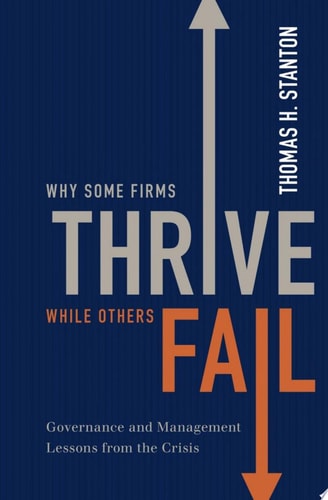
Why Some Firms Thrive While Others Fail: Governance and Management Lessons from the Crisis
0
0
As an Amazon Associate and affiliate partner, Menrva Books earns from qualifying purchases. Learn more
Author Description
The financial crisis revealed fundamental shortcomings in both public and private American institutions. While the firms that were successful each found their own way to weather the crisis, unsuccessful firms were remarkably alike in their inability to cope and in the mistakes they made.Combing through the wreckage, Thomas H. Stanton examines which financial firms survived the crisis and which ones failed. He analyzes how differences in governance, organization, and management between these firms led to their success or failure, and how government supervision and regulation failed to prevent the crisis. Based on interviews that the Financial Crisis Inquiry Commission conducted with CEOs, risk officers, traders, and others at major financial firms, Stanton systematically outlines how successful firms, like JP Morgan Chase, Goldman Sachs, Wells Fargo, and others used a multitude of approaches to distinguish themselves in operational competence and intelligent discipline, while unsuccessful firms, like Fannie Mae, Freddie Mac, and Countrywide, and others uniformly failed to prepare for possible low-probability, high-impact events. Stanton concludes by issuing a call for strengthening organizational design, governance, and risk management, by identifying clear attributes that distinguish successful firms from the others.Why Some Firms Thrive While Others Fail is an invaluable resource for company officials and policymakers on the development of a risk-sensitive, more-successful culture. It also provides an essential foundation on culture and governance for students of business and public policy, practitioners within the public and private financial institutions at the center of the recent financial crisis, and those at risk of playing roles in possible future crises.
Menrva's Summary
THE THESIS
This book investigates the specific organizational, governance, and management factors that determined why certain financial institutions survived the 2008 financial crisis while others collapsed. Thomas H. Stanton, drawing upon his expertise in public policy and institutional design, utilizes primary source data from the Financial Crisis Inquiry Commission to contrast the operational behaviors of successful firms against those that failed. He argues that the disparity in outcomes was not merely a matter of market conditions, but a direct result of internal risk-sensitive cultures and the presence or absence of disciplined management frameworks.
THE SCOPE MAP
What You Will Find
- Comparative analysis of major financial institutions including JP Morgan Chase, Goldman Sachs, Fannie Mae, and Countrywide.
- Evaluation of government supervision and regulatory efficacy during the 2008 financial crisis.
- Qualitative data derived from interviews with CEOs, risk officers, and traders conducted by the Financial Crisis Inquiry Commission.
- Frameworks for strengthening organizational design and risk-sensitive corporate culture.
THE AUTHORITY PERSPECTIVE
Experts and practitioners in the fields of business and public policy identify this work as a critical examination of institutional failure and success. Readers frequently note the clarity with which Stanton translates complex regulatory and management failures into actionable lessons for modern corporate governance.
Page Count:
292
Publication Date:
2012-07-05
Publisher:
Oxford University Press
ISBN-10:
0199915997
ISBN-13:
9780199915996
Business
Economics
Corporate governance
Management
Principles of Management
Finance
Corporations
Community Tags
Similar Books