
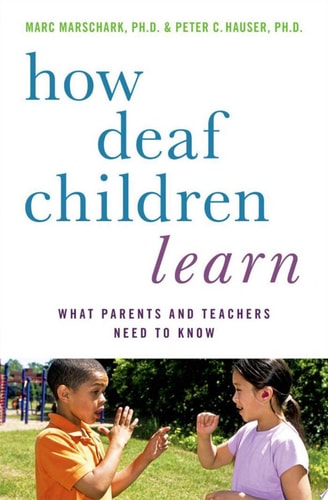
How Deaf Children Learn: What Parents and Teachers Need to Know
0
0
As an Amazon Associate and affiliate partner, Menrva Books earns from qualifying purchases. Learn more
Author Description
How can parents and teachers most effectively support the language development and academic success of deaf and hard-of-hearing children? Will using sign language interfere with learning spoken language? Should deaf children be placed in classrooms with hearing children? Are traditional methods of teaching subjects such as reading and math to hearing children appropriate for deaf learners? As many parents and teachers will attest, questions like these have no easy answers, and it can be difficult for caring adults to separate science from politics and fact from opinion in order to make informed decisions about how to help deaf children learn. In this invaluable guide, renowned authorities Marc Marschark and Peter Hauser highlight important new advances in scientific and educational research that can help parents and teachers of students with significant hearing loss. The authors stress that deaf children have strengths and needs that are sometimes very different from those who can hear. Consequently, if deaf students are to have full academic access and optimal educational outcomes, it is essential that parents and teachers learn to recognize these differences and adjust their teaching methods to them. Marschark and Hauser explain how the fruits of research conducted over the last several years can markedly improve educational practices at home and in the classroom, and they offer innovative strategies that parents and teachers can use to promote learning in their children. The result is a lively, accessible volume that sheds light on what it means to be a deaf learner and that provides a wealth of advice on how we can best support their language development, social skills, and academic success.
Menrva's Summary
THE THESIS
How can parents and teachers most effectively support the language development and academic success of deaf and hard-of-hearing children? Marc Marschark and Peter C. Hauser, both established researchers in the field of deafness, synthesize recent scientific findings to address the complex intersection of educational policy and practical pedagogy. The authors argue that deaf children possess distinct cognitive and developmental profiles that require specialized instructional adjustments rather than a one-size-fits-all approach.
THE SCOPE MAP
What You Will Find
- Analysis of language acquisition pathways including sign language and spoken language development.
- Evidence-based strategies for teaching core subjects like reading and mathematics to deaf learners.
- Examination of classroom placement models and their impact on social and academic outcomes.
- Practical guidance for distinguishing between ideological debates and empirical research in deaf education.
THE AUTHORITY PERSPECTIVE
Experts recognize this volume as a foundational resource for educators and caregivers navigating the complexities of deaf education. Readers frequently note the balance between rigorous research and accessible, actionable advice for classroom and home environments.
Page Count:
168
Publication Date:
2011-01-01
Publisher:
Oxford University Press
ISBN-10:
0199912483
ISBN-13:
9780199912483
Psychology
Parenting
Deaf Studies
Family & Consumer Sciences
Education
Special Education
Community Tags
Other Editions(2)
Similar Books




Reader Comments
Share Your Thoughts
No comments yet. Be the first to share your thoughts!