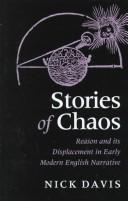
Stories of Chaos
0
0
As an Amazon Associate and affiliate partner, Menrva Books earns from qualifying purchases. Learn more
Author Description
Stories of Chaos re-examines narrative design in Sir Gawain and the Green Knight, The Faerie Queene, King Lear and Paradise Lost. Written in a period newly set on finding practical application for available systems of reasoning, these texts confront in their different ways reason's absolute limitation in the face of a Real which it cannot adequately represent to itself or recruit to its own purposes. An influential model for the staging of such a confrontation was the mythic, cosmological narrative of Plato's Timaeus. In their rewriting of Plato's narrative the English texts deploy but also destabilize the ancient conceptual polarization of the 'rational' and the 'irrational' or 'chaotic', rethought in the terms offered by their period's innovatory practices of reasoning. The study establishes the critical importance of telling a story of chaos by comparing the narrative method of its chosen texts with that adopted by Freud and Lacan as a means of reflection on the psychoanalytic encounter with an ultimately chaotic Real.
Menrva's Summary
THE THESIS
This book investigates the confrontation between reason and the ineffable 'Real' as depicted in seminal English literary works and psychoanalytic theory. Davis examines how Sir Gawain and the Green Knight, The Faerie Queene, King Lear, and Paradise Lost, alongside the philosophical narrative of Plato's Timaeus, explore the limitations of reason in representing or controlling chaotic forces. The study posits that these texts, by rewriting Plato's cosmological narrative, both utilize and subvert the ancient dichotomy of rational versus irrational. It further draws parallels between their narrative methods and those of Freud and Lacan in their engagement with the psychoanalytic encounter with a fundamentally chaotic Real.
THE SCOPE MAP
- Analysis of narrative design in Sir Gawain and the Green Knight
- Examination of The Faerie Queene's engagement with reason's limitations
- Exploration of King Lear's confrontation with the irrational
- Re-examination of Paradise Lost in the context of chaos and reason
- Comparison with Plato's Timaeus as a model for staging reason's limits
- Discussion of how English texts destabilize the 'rational'/'irrational' polarization
- Comparative analysis of narrative methods with Freud and Lacan
THE AUTHORITY PERSPECTIVE
This work is positioned as a scholarly examination of literary and psychoanalytic texts, focusing on the philosophical underpinnings of narrative and reason. Its comparative approach, linking classical literature with modern psychoanalytic thought, suggests a dense, analytical text intended for an academic audience. The book's engagement with foundational texts like Plato, Shakespeare, and Milton, alongside Freud and Lacan, indicates a deep dive into the theoretical frameworks surrounding chaos and representation.
Page Count:
195
Publication Date:
1999-01-01
ISBN-10:
1840146494
History
Philosophy
Poetry
Classics
Non-Fiction
Literary theory
Literary Criticism
Community Tags
Similar Books