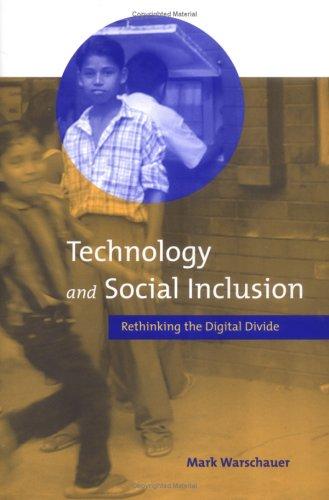
Technology and Social Inclusion
0
0
As an Amazon Associate and affiliate partner, Menrva Books earns from qualifying purchases. Learn more
Author Description
Drawing on theory from political science, economics, sociology, psychology, communications, education, and linguistics, this book examines the ways in which differing access to technology contributes to social and economic stratification or inclusion. The author takes a global perspective, presenting case studies from developed and developing countries, including Brazil, China, Egypt, India, and the United States. A central premise is that, in today's society, the ability to access, adapt, and create knowledge using information and communication technologies is critical to social inclusion. This focus on social inclusion shifts the discussion of the "digital divide" from gaps to be overcome by providing equipment to social development challenges to be addressed through the effective integration of technology into communities, institutions, and societies. What is most important is not so much the physical availability of computers and the Internet but rather people's ability to make use of those technologies to engage in meaningful social practices.
Menrva's Summary
THE THESIS
This book investigates how differential access to technology shapes social and economic stratification or inclusion on a global scale. Drawing on theories from multiple disciplines, the author argues that the capacity to utilize information and communication technologies for knowledge creation and adaptation is paramount to social inclusion in contemporary society. The work moves beyond a simplistic view of the 'digital divide' as merely an equipment gap, reframing it as a challenge of integrating technology effectively into communities and institutions. The core argument emphasizes that meaningful engagement with technology, rather than mere physical availability, is the critical factor for societal participation.
THE SCOPE MAP
- Analysis of social and economic stratification through the lens of technology access.
- Global case studies from developed and developing countries (Brazil, China, Egypt, India, USA).
- Theoretical frameworks from political science, economics, sociology, psychology, communications, education, and linguistics.
- A reframing of the 'digital divide' from equipment provision to social development challenges.
- Emphasis on the ability to adapt and create knowledge using ICTs as key to social inclusion.
- Focus on meaningful social practices enabled by technology, not just its physical presence.
THE AUTHORITY PERSPECTIVE
The book is recognized for its interdisciplinary approach, synthesizing theories from various social sciences and humanities to examine the complex relationship between technology and social inclusion. Its global perspective, supported by diverse case studies, offers a nuanced understanding of the digital divide that extends beyond mere access to equipment. The author's central premise highlights the critical role of knowledge creation and adaptation using ICTs for meaningful societal participation. This work is positioned as a significant contribution to discussions on technology's impact on social and economic equity.
Page Count:
274
Publication Date:
2004-01-01
ISBN-10:
0262731738
ISBN-13:
9780262731737
Non-Fiction
Economics
Science & Technology
Technology
Linguistics
Education
Digital divide
Sociology
Community Tags
Similar Books