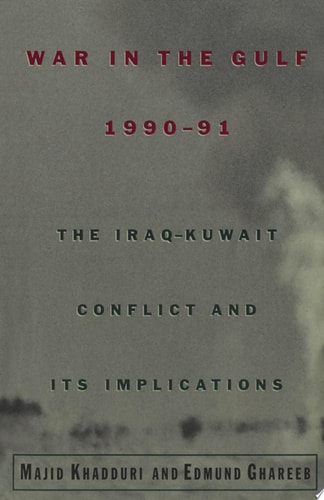
War in the Gulf, 1990-91: The Iraq-Kuwait Conflict and Its Implications
0
0
As an Amazon Associate and affiliate partner, Menrva Books earns from qualifying purchases. Learn more
Author Description
For most Americans, the war against Iraq lingers in memory as a vast morality play, a drama offering ready made heroes and villains: a glowering dictator in military uniform, hapless Kuwaiti refugees with tales of persecution, plucky pilots with high-tech wizardry, and a defiant American president, ringing Churchillian as he drew a line in the sand. But this characterization of the war is greatly oversimplified, a one-dimensional portrait, lacking in context and nuance. In War in the Gulf, 1990 91, eminent scholars Majid Khadduri and Edmund Ghareeb paint a very different picture, one that brings historical depth to the portrait, and displays the actions of many of the participants in a new and revealing light. Khadduri and Ghareeb offer a far more accurate and complex portrait of the Iraq-Kuwait conflict, providing a wealth of background information not readily available before. They made a distinction between the differences between Iraq and Kuwait over frontiers, territory, and sovereignty and the method pursued by Iraqi leaders to resolve those differences. They explore, for instance, the history of relations between Iraq and Kuwait, revealing that Kuwait had once been a part of Basra (in southern Iraq) during the Ottoman rule, and only became a separate country while under British control (it was the British in fact who drew the much-disputed boundary line between Iraq and Kuwait). Khadduri and Ghareeb describe the many decades of struggle to resolve the boundary issue, examining the repeated attempts by other Arab states to mediate according to Islamic traditions of consultation and peaceful resolution within the faith. The authors also show how Saddam Husayn's war with Iran exacerbated the boundary tensions. Because of the decade-long war, Iraq badly needed oil revenue to repay wartime loans and to rebuild, but Kuwait persisted in pumping far beyond its OPEC quota, driving down prices, and costing Iraq billions of dollars of revenue. The book reveals how Kuwai
Menrva's Summary
THE THESIS
This work investigates the complex historical, territorial, and economic origins of the 1990-91 Iraq-Kuwait conflict, challenging the simplistic morality-play narrative prevalent in Western media. Authors Majid Khadduri and Edmund Ghareeb, both established scholars of Middle Eastern affairs, utilize historical records and regional diplomatic archives to move beyond surface-level characterizations. They argue that the conflict was rooted in long-standing disputes over sovereignty and borders, exacerbated by the economic pressures Iraq faced following the Iran-Iraq War.
THE SCOPE MAP
What You Will Find
- Historical analysis of the Iraq-Kuwait border disputes dating back to the Ottoman era.
- Examination of British colonial influence on regional boundary demarcation.
- Analysis of the economic impact of OPEC quota violations on Iraqi post-war recovery.
- Documentation of failed mediation attempts by regional Arab states using traditional diplomatic frameworks.
THE AUTHORITY PERSPECTIVE
Experts recognize this text as a critical corrective to Western-centric interpretations of the Gulf War, providing necessary historical context for the geopolitical tensions of the era. Readers frequently note the academic density of the prose, which serves as a foundational resource for understanding the long-term structural causes of the conflict.
Page Count:
312
Publication Date:
2001-01-01
Publisher:
Oxford University Press
ISBN-10:
0199923868
ISBN-13:
9780199923861
History
Middle East
Military History
Middle Eastern
International relations
Community Tags
Other Editions(2)

Similar Books





Reader Comments
Share Your Thoughts
No comments yet. Be the first to share your thoughts!