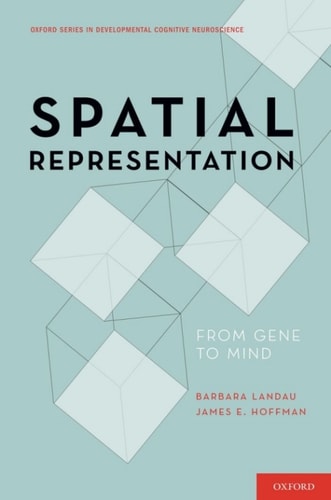
Spatial Representation: From Gene to Mind
0
0
As an Amazon Associate and affiliate partner, Menrva Books earns from qualifying purchases. Learn more
Author Description
Our experience of the spatial world is a unitary one; we perceive objects and layouts, we remember them and act on them, and we can even talk about them with ease. Despite this impression of seamlessness, spatial representations in human adults appear to be specialized in domain-dependent manner, engaging different properties and computational mechanisms for different functions. In this book, the authors present evidence that this domain-specific specialization in cognitive function emerges early in development and is reflected in patterns of breakdown that occur under genetic defect. The authors focus on spatial representation in children and adults with Williams syndrome, a relatively rare genetic syndrome that gives rise to an unusual profile of severely impaired spatial representation together with spared language. Results from a variety of spatial domains -- including object representation, motion perception, action, navigation, and spatial language -- appear to display a strikingly uneven profile of sparing and deficit within spatial representations, consistent with the idea that specialization of function drives development and breakdown. These findings raise a crucial question: Can specific genes target specific aspects of cognitive structure? Looking deeper into the patterns of performance across spatial domains, the book explores the notion that understanding patterns of normal development across domains is crucial to understanding unusual development. Using insights from normal development, the authors propose a speculative hypothesis that explains the emergence of the William syndrome profile, and how complex cognitive outcomes can arise from the deletion of a small set of genes.
Menrva's Summary
THE THESIS
Can specific genes target specific aspects of cognitive structure to produce the uneven spatial representation profiles observed in individuals with Williams syndrome? The authors, Barbara Landau and James E. Hoffman, utilize their expertise in cognitive science and developmental neuroscience to examine the relationship between genetic defects and cognitive function. By comparing normal developmental patterns with the specific deficits found in Williams syndrome, they propose a framework for understanding how complex cognitive outcomes emerge from limited genetic deletions.
THE SCOPE MAP
What You Will Find
- Analysis of spatial domains including object representation, motion perception, action, and navigation.
- Examination of the cognitive profile associated with Williams syndrome.
- Integration of developmental psychology and genetic research methodologies.
- A hypothesis regarding the modularity of spatial representation and its breakdown.
THE AUTHORITY PERSPECTIVE
Experts recognize this work as a significant contribution to the study of domain-specific cognitive development and the neurobiology of genetic syndromes. Readers frequently note the academic density of the prose, which serves as a foundational text for those interested in the intersection of genetics and cognitive architecture.
Page Count:
392
Publication Date:
2012-01-01
Publisher:
Oxford University Press
ISBN-10:
0199921377
ISBN-13:
9780199921379
Psychology
Science
Developmental Psychology
Genetics
Neuroscience
Community Tags
Similar Books