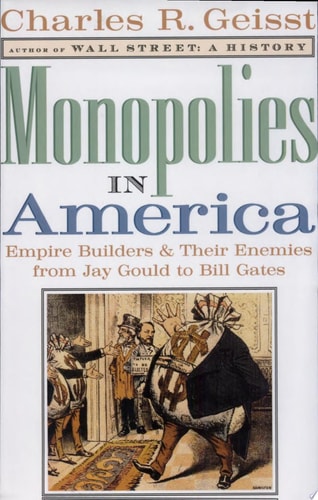
Monopolies in America: Empire Builders and Their Enemies from Jay Gould to Bill Gates
0
0
As an Amazon Associate and affiliate partner, Menrva Books earns from qualifying purchases. Learn more
Author Description
In this incisive and comprehensive history, business historian Charles Geisst traces the rise of monopolies from the railroad era to today's computer software empires. The history of monopolies has been dominated by strong and charismatic personalities. Geisst tells the stories behind the individuals--from John D. Rockefeller and Andrew Carnegie to Harold Geneen and Bill Gates--who forged these business empires with genius, luck, and an often ruthless disregard for fair competition. He also analyzes the viewpoints of their equally colorful critics, from Louis Brandeis to Ralph Nader. These figures enliven the narrative, offering insight into how large businesses accumulate power. Viewed as either godsends or pariahs, monopolies have sparked endless debate and often conflicting responses from Washington. Monopolies in America surveys the important pieces of legislation and judicial rulings that have emerged since the post-Civil War era, and proposes that American antitrust activity has had less to do with hard economics than with political opinion. What was considered a monopoly in 1911 when Standard Oil and American Tobacco were broken up was not applied again when the Supreme Court refused to dismantle U.S. Steel in 1919. Charting the growth of big business in the United States, Geisst reaches the startling conclusion that the mega-mergers that have dominated Wall Street headlines for the past fifteen years are not simply a trend, but a natural consequence of American capitalism. Intelligent and informative, Monopolies in America skillfully chronicles the course of American big business, and allows us to see how the debate on monopolies will be shaped in the twentieth-first century.
Menrva's Summary
THE THESIS
This book investigates the historical evolution of American monopolies and the shifting political and judicial responses to corporate power from the post-Civil War era to the modern age. Charles R. Geisst, a noted business historian, utilizes a combination of biographical profiles and legal analysis to argue that antitrust activity in the United States is driven more by fluctuating political sentiment than by consistent economic theory. By examining the trajectories of figures like John D. Rockefeller and Bill Gates, the author demonstrates how mega-mergers represent a recurring, natural outcome of the American capitalist system rather than an anomalous trend.
THE SCOPE MAP
What You Will Find
- A chronological survey of corporate expansion from the railroad era to the software industry.
- Analysis of landmark antitrust legislation and Supreme Court rulings, including the dissolution of Standard Oil.
- Biographical case studies of influential empire builders and their vocal critics, such as Louis Brandeis and Ralph Nader.
- A critical examination of the political motivations behind government intervention in large-scale business operations.
THE AUTHORITY PERSPECTIVE
Experts and readers recognize this work as a comprehensive historical overview that effectively bridges the gap between economic history and political biography. The text is noted for its accessible prose, making complex legal and economic concepts clear for those interested in the history of American corporate power.
Page Count:
368
Publication Date:
2000-01-01
Publisher:
Oxford University Press
ISBN-10:
0199923671
ISBN-13:
9780199923670
Business
Economics
Biography
History
Politics
Economics history
Capitalism
American History