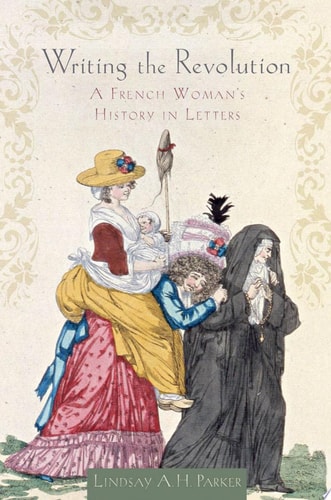
Writing the Revolution: A French Woman's History in Letters
0
0
As an Amazon Associate and affiliate partner, Menrva Books earns from qualifying purchases. Learn more
Author Description
Writing the Revolution is a microhistory of a middle-class Parisian woman, Rosalie Jullien, whose nearly 1,000 familiar letters have never before been studied. The Jullien name is not new to histories of the French Revolution. Rosalie's son, Marc-Antoine, known in the family as Jules, was closely connected to the Committee of Public Safety during the Reign of Terror. However, despite being the wife and mother of revolutionary elites, Rosalie led a private life. Connected to the Revolution in very personal ways, she was also distanced from the lime light because of her gender and her proclivity for modesty. Her correspondence allows readers to enter her private world and see the intellectual, emotional, and familial life of a revolutionary in all of its complexity.The prevailing thesis in the field holds that the revolutionary elite constructed the New Regime against women, effectively excluding them from the political sphere, although nearly every existing study of women has approached the subject through oblique sources and mostly male voices. Rosalie Jullien's long missives to her husband and son, however, document her relationship to politics as she explained it. Despite never seeking a public role, Rosalie developed a political identity that included a revolutionized understanding of womanhood. Writing the Revolution builds on the innovative scholarship on the history of the family during the Revolution and demonstrates how the family sphere was revolutionized even in cases where the wife maintained a traditional family role.Jullien's correspondence boasts many values as an artifact of the Revolutionary experience, of women's lives, and of epistolary culture. Rosalie demonstrates the individual's experience within the evolving structures of a modernizing state, family, and gender identity. The period covered spans from 1775 to 1810. A portrayal of Rosalie's early married life, and the decade she spent with her husband and children in a small town north of Grenoble.
Menrva's Summary
THE THESIS
This work investigates how the private correspondence of Rosalie Jullien challenges established historical narratives regarding the exclusion of women from the political sphere during the French Revolution. Lindsay A. H. Parker utilizes a previously unstudied collection of nearly 1,000 letters to reconstruct the life of a woman connected to revolutionary elites. The author argues that Jullien developed a distinct political identity and a revolutionized understanding of womanhood, even while maintaining a traditional domestic role. By focusing on these primary source documents, the book provides a nuanced perspective on the intersection of family life and state-level political upheaval.
THE SCOPE MAP
What You Will Find
- A detailed analysis of 1,000 previously unstudied letters written by Rosalie Jullien between 1775 and 1810.
- An examination of the domestic sphere as a site of political development during the French Revolution.
- A microhistorical methodology that contrasts the public actions of revolutionary elites with the private experiences of their families.
- Evidence regarding the evolution of gender identity and family structures within a modernizing state.
THE AUTHORITY PERSPECTIVE
Scholars recognize this text as a significant contribution to the study of the French Revolution through the lens of gender and domestic history. Readers frequently note the meticulous archival research and the clarity with which the author contextualizes Jullien's personal letters within the broader political landscape of the era.
Page Count:
224
Publication Date:
2013-06-19
Publisher:
Oxford University Press
ISBN-10:
019993102X
ISBN-13:
9780199931026
Biography
History
Paris France
French Revolution
Microhistory
Epistolary
Letter Writing
Women france