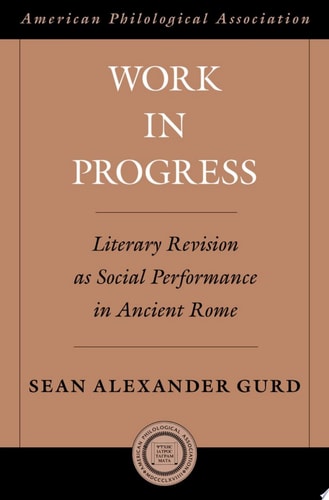
Work in Progress: Literary Revision as Social Performance in Ancient Rome
0
0
As an Amazon Associate and affiliate partner, Menrva Books earns from qualifying purchases. Learn more
Author Description
Work in Progress offers an in-depth study of the role of literary revision in the compositional practices and representational strategies of Roman authors at the end of the republic and the beginning of the principate. It focuses on Cicero, Horace, Quintilian, Martial, and Pliny the Younger, but also offers discussions of Isocrates, Plato, and Hellenistic poetry. The book's central argument is that revision made textuality into a medium of social exchange. Revisions were not always made by authors working alone: often, they were the result of conversations between an author and friends or literary contacts, and these conversations exemplified a commitment to collective debate and active collaboration. Revision was thus much more than an unavoidable element in literary genesis: it was one way in which authorship became a form of social agency. Consequently, when we think about revision for authors of the late republic and early empire we should not think solely of painstaking attendance to craft aimed exclusively at the perfection of a literary work. Nor should we think of the resulting texts as closed and invariant statements sent from an author to his reader. So long as an author was still willing to revise, his text served as a temporary platform around and in which a community came into being.The theories of revision that guide the author's study come from the new genetic criticism that has been successfully applied, especially in Europe, to modern authors. While many of the tools of analysis applicable to modern authors (author-written manuscripts, corrected proofs, etc.) are not available for ancient authors, Sean Gurd has amassed a surprising number of passages in ancient texts about revision, its importance to the author, and the circle of critics involved in the process of rewriting.
Menrva's Summary
THE THESIS
This book investigates how the practice of literary revision in ancient Rome functioned as a mechanism for social performance and collective intellectual exchange rather than merely a solitary pursuit of textual perfection. Sean Alexander Gurd, a scholar of classical literature, utilizes a framework derived from modern genetic criticism to re-examine the compositional habits of Roman writers. By analyzing references to rewriting and editorial feedback within ancient texts, Gurd argues that the act of revision served as a platform for building communities and asserting social agency during the late Republic and early Principate.
THE SCOPE MAP
What You Will Find
- Analysis of compositional practices in works by Cicero, Horace, Quintilian, Martial, and Pliny the Younger
- Theoretical applications of genetic criticism to ancient literary production
- Examination of the role of friends and literary contacts in the revision process
- Discussions on the influence of Isocrates, Plato, and Hellenistic poetry on Roman thought
Scope Limits
- The study does not cover the full breadth of Roman literature, focusing primarily on the transition from the Republic to the Principate
- The analysis is constrained by the lack of physical manuscripts or corrected proofs, relying instead on textual evidence of the revision process
THE AUTHORITY PERSPECTIVE
Scholars recognize this work as a significant contribution to the study of ancient authorship and the social dimensions of textual production. Readers frequently note the academic density of the prose, which effectively bridges the gap between classical philology and modern literary theory.
Page Count:
192
Publication Date:
2011-01-01
Publisher:
Oxford University Press
ISBN-10:
0190208716
ISBN-13:
9780190208714
History
English & College Success
Philology
English
Literary Criticism
Ancient History
Ancient - Rome
Community Tags
Other Editions(2)
Similar Books





Reader Comments
Share Your Thoughts
No comments yet. Be the first to share your thoughts!