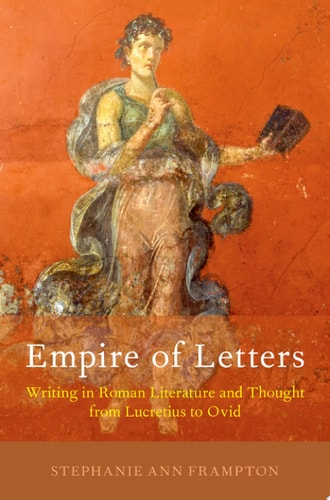
Empire of Letters: Writing in Roman Literature and Thought from Lucretius to Ovid
0
0
As an Amazon Associate and affiliate partner, Menrva Books earns from qualifying purchases. Learn more
Author Description
Shedding new light on the history of the book in antiquity, Empire of Letters tells the story of writing at Rome at the pivotal moment of transition from Republic to Empire (c. 55 BCE-15 CE). By uniting close readings of the period's major authors with detailed analysis of material texts, it argues that the physical embodiments of writing were essential to the worldviews and self-fashioning of authors whose works took shape in them. Whether in wooden tablets, papyrus bookrolls, monumental writing in stone and bronze, or through the alphabet itself, Roman authors both idealized and competed with writing's textual forms.The academic study of the history of the book has arisen largely out of the textual abundance of the age of print, focusing on the Renaissance and after. But fewer than fifty fragments of classical Roman bookrolls survive, and even fewer lines of poetry. Understanding the history of the ancient Roman book requires us to think differently about this evidence, placing it into the context of other kinds of textual forms that survive in greater numbers, from the fragments of Greek papyri preserved in the garbage heaps of Egypt to the Latin graffiti still visible on the walls of the cities destroyed by Vesuvius. By attending carefully to this kind of material in conjunction with the rich literary testimony of the period, Empire of Letters exposes the importance of textuality itself to Roman authors, and puts the written word back at the center of Roman literature.
Menrva's Summary
THE THESIS
This work investigates how the physical materiality of writing—from papyrus rolls to monumental inscriptions—shaped the intellectual identity and literary production of Roman authors during the transition from Republic to Empire. Stephanie Ann Frampton, a scholar of classical literature, synthesizes material evidence with canonical texts to argue that Roman writers were deeply preoccupied with the physical forms their words occupied. By examining the interplay between text and medium, the author demonstrates that the act of writing was not merely a vehicle for content but a central component of Roman self-fashioning and cultural authority.
THE SCOPE MAP
What You Will Find
- Analysis of Roman literary production between 55 BCE and 15 CE.
- Examination of diverse textual media including wooden tablets, papyrus bookrolls, and stone inscriptions.
- Integration of archaeological evidence, such as graffiti and papyri fragments, with literary analysis of authors like Lucretius and Ovid.
Scope Limits
- The study focuses specifically on the Roman transition period and does not provide a comprehensive history of the book across all of antiquity.
- It does not prioritize the post-print history of the book, focusing instead on the unique material constraints of the classical era.
THE AUTHORITY PERSPECTIVE
Scholars recognize this text as a significant contribution to the field of classical studies for its innovative approach to material culture. Readers frequently note the academic density of the prose, which requires a foundational understanding of Roman literature to fully appreciate the author's arguments.
Page Count:
219
Publication Date:
2019-01-01
Publisher:
Oxford University Press
ISBN-10:
0190915420
ISBN-13:
9780190915421
History
Writing
Ancient History
English
Literary Criticism
Book History
English & College Success
Rome
Ancient - Rome
Criticism history
Community Tags
Similar Books