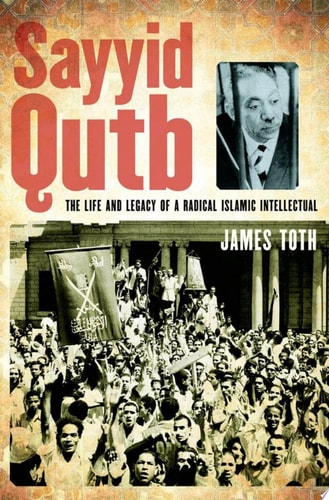
Sayyid Qutb: The Life and Legacy of a Radical Islamic Intellectual
0
0
As an Amazon Associate and affiliate partner, Menrva Books earns from qualifying purchases. Learn more
Author Description
Sayyid Qutb is widely considered the guiding intellectual of radical Islam, with a direct line connecting him to Osama bin Laden. But Qutb has too often been treated maliciously or reductively-"the Philosopher of Islamic Terror," as Paul Berman famously put it in the New York Times Magazine. James Toth offers an even-handed account of Sayyid Qutb and shows him to be a much more complex figure than the many one-dimensional portraits would have us believe. Qutb first gained notice as a novelist, literary critic, and poet but then turned to religious and political criticism aimed at the Egyptian government and Muslims he deemed insufficiently pious. After a two-year sojourn in the U.S., he returned to Egypt even more radicalized and joined the Muslim Brotherhood, eventually taking charge of its propaganda operation. When Brotherhood members were accused of assassinating Egyptian President Gamal Abdel Nasser, the group was outlawed and Qutb imprisoned. He was executed in 1966, becoming the first martyr to the Islamist cause. Using an analytical approach that investigates without passing judgment, Toth traces the life and thought of Qutb, giving attention not only to his well-known Signposts on the Road, but also to his less-studied works like Social Justice in Islam and his 30-volume Qur'anic commentary, In the Shade of the Qur'an. Toth's aim is to give Qutb's ideas a fair hearing, to measure their impact, and to treat him like other intellectuals who inspire revolutions, however unpopular they may be. In offering a more nuanced account of Qutb, one that moves beyond the cartoonish depictions of him as the evil genius lurking behind today's terrorists, Sayyid Qutb deepens our understanding of a central figure of radical Islam and, indeed, our understanding of radical Islam itself.
Menrva's Summary
THE THESIS
This work investigates the intellectual evolution of Sayyid Qutb to determine how his writings and experiences shaped the trajectory of radical Islamic thought. James Toth, an anthropologist and scholar of Middle Eastern studies, utilizes a biographical framework to move beyond reductive labels of Qutb as merely a terrorist figurehead. By examining Qutb's early literary career, his time in the United States, and his eventual leadership within the Muslim Brotherhood, Toth argues that Qutb must be understood as a complex intellectual whose ideas were deeply rooted in his specific historical and political context.
THE SCOPE MAP
What You Will Find
- A detailed examination of Qutb's transition from a literary critic and poet to a prominent religious and political theorist.
- Analysis of primary texts including 'Social Justice in Islam', 'Signposts on the Road', and the 30-volume 'In the Shade of the Qur'an'.
- Historical context regarding the Egyptian political climate under Gamal Abdel Nasser and the subsequent suppression of the Muslim Brotherhood.
- An analytical methodology that prioritizes historical objectivity over moralizing narratives to assess Qutb's influence on modern Islamist movements.
THE AUTHORITY PERSPECTIVE
Experts and readers frequently note that this text provides a necessary, balanced alternative to the polarized portrayals of Qutb common in Western media. The prose is recognized for its academic rigor and its ability to contextualize Qutb's radicalization within the broader history of 20th-century Egypt.
Page Count:
393
Publication Date:
2013-01-01
Publisher:
Oxford University Press
ISBN-10:
0199969604
ISBN-13:
9780199969609
Religion
Biography
History
Islam
Muslims africa
Scholars
Community Tags
Similar Books