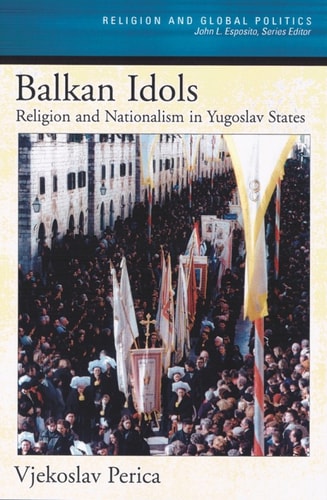
Balkan Idols: Religion and Nationalism in Yugoslav States
0
0
As an Amazon Associate and affiliate partner, Menrva Books earns from qualifying purchases. Learn more
Author Description
Reporting from the heartland of Yugoslavia in the 1970s, Washington Post correspondent Dusko Doder described "a landscape of Gothic spires, Islamic mosques, and Byzantine domes." A quarter century later, this landscape lay in ruins. In addition to claiming tens of thousands of lives, the former Yugoslavia's four wars ravaged over a thousand religious buildings, many purposefully destroyed by Serbs, Albanians, and Croats alike, providing an apt architectural metaphor for the region's recent history. Rarely has the human impulse toward monocausality--the need for a single explanation--been in greater evidence than in Western attempts to make sense of the country's bloody dissolution. From Robert Kaplan's controversial Balkan Ghosts, which identified entrenched ethnic hatreds as the driving force behind Yugoslavia's demise to NATO's dogged pursuit and arrest of Slobodan Milosevic, the quest for easy answers has frequently served to obscure the Balkans' complex history. Perhaps most surprisingly, no book has focused explicitly on the role religion has played in the conflicts that continue to torment southeastern Europe. Based on a wide range of South Slav sources and previously unpublished, often confidential documents from communist state archives, as well as on the author's own on-the-ground experience, Balkan Idols explores the political role and influence of Serbian Orthodox, Croatian Catholic, and Yugoslav Muslim religious organizations over the course of the last century. Vjekoslav Perica emphatically rejects the notion that a "clash of civilizations" has played a central role in fomenting aggression. He finds no compelling evidence of an upsurge in religious fervor among the general population. Rather, he concludes, the primary religious players in the conflicts have been activist clergy. This activism, Perica argues, allowed the clergy to assume political power without the accountablity faced by democratically-elected officials. What emerges from Perica's account is a sobering analysis of how religious institutions can be co-opted for nationalist agendas.
Menrva's Summary
THE THESIS
This book investigates the extent to which religious institutions and clergy influenced the political instability and eventual dissolution of the Yugoslav state. Vjekoslav Perica, a scholar of the region, utilizes previously confidential communist state archives and primary source documents to challenge the popular narrative of ancient ethnic hatreds. He argues that the conflicts were not driven by a grassroots religious revival, but rather by the calculated political activism of religious leaders who operated without democratic oversight.
THE SCOPE MAP
What You Will Find
- Analysis of Serbian Orthodox, Croatian Catholic, and Yugoslav Muslim religious organizations.
- Examination of political influence exerted by clergy during the 20th century.
- Evidence derived from internal communist state archives and regional South Slav sources.
Scope Limits
- The text does not provide a comprehensive military history of the Yugoslav wars.
- It does not focus on the personal theological beliefs of the general population, but rather on institutional political behavior.
THE AUTHORITY PERSPECTIVE
Scholars and regional experts recognize this work as a significant contribution to the study of religion in post-communist politics. Readers frequently note the academic density of the prose and the author's rigorous use of archival evidence to dismantle simplistic cultural explanations for the conflict.
Page Count:
362
Publication Date:
2002-01-01
Publisher:
Oxford University Press
ISBN-10:
0190287497
ISBN-13:
9780190287498
Religion
History
European History
Nationalism
Islam
Sociology
International relations
Balkan Studies
Community Tags
Similar Books










Reader Comments
Share Your Thoughts
No comments yet. Be the first to share your thoughts!