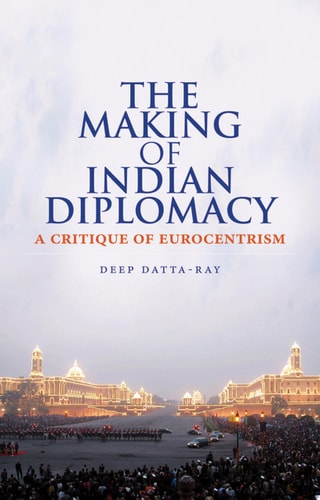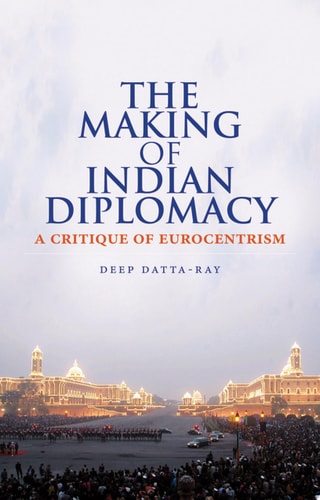
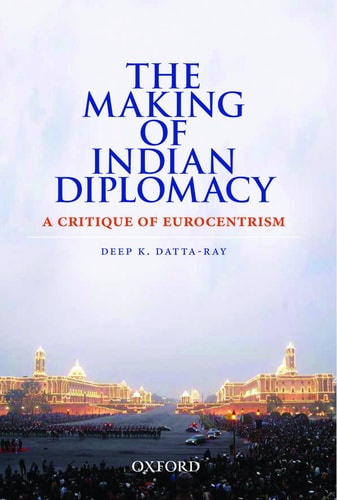
The Making of Indian Diplomacy: A Critique of Eurocentrism
0
0
As an Amazon Associate and affiliate partner, Menrva Books earns from qualifying purchases. Learn more
Author Description
Deep K Datta-Ray is the only outsider to have embedded in India's Ministry of External Affairs. His book on Indian diplomacy overturns much of the accepted wisdom of it being a derivative of European colonial models, in the process shedding new light on the Indian state.The author argues on the basis of observed practices, and informal interactions and interviews with the Prime Minister, Cabinet Ministers and diplomats, that the core of Indian diplomatic practice is to be found in the national epic, the Mahabharata, whose influence is traced from pre-Mughal times to the present. Moreover the durability of the Mahabharata's influence on Indian diplomacy was secured by India's most significant relationship of the modern political era: between Mohandas Gandhi and Jawaharlal Nehru. The epic inspired Gandhi's innovative conception of terminating violence non-violently, or satyagraha. His influence over Nehru ensured that satyagraha would shape the new post-colonial nation's diplomacy, testimony to which, and arguably its greatest achievement, is India's nuclear diplomacy.Dr Datta-Ray's investigation of Indian diplomacy reveals its non-Western rationale, while its presence at the heart of a state presumed Western at inception reveals new possibilities about how to conceptualize post-colonial India, its purpose and role on the world stage. While nation states authorised by nationalism remain hostage to the past, the Indian state's arena for action is very much the present, as its rational objective of non-violently terminating violence now.
Menrva's Summary
THE THESIS
This book investigates whether Indian diplomatic practice is a derivative of European colonial models or if it possesses a distinct, indigenous rationale rooted in historical epics. Dr. Deep K. Datta-Ray, having embedded within India's Ministry of External Affairs, utilizes a combination of ethnographic observation, informal interviews with high-level officials, and historical analysis. He argues that the Mahabharata serves as the foundational framework for Indian diplomacy, a tradition sustained through the political partnership of Mohandas Gandhi and Jawaharlal Nehru. By tracing these influences, the author posits that India's foreign policy objectives are driven by a non-Western logic centered on the non-violent termination of violence.
THE SCOPE MAP
What You Will Find
- Analysis of the Mahabharata as a primary influence on modern statecraft.
- Examination of the Gandhi-Nehru relationship and its impact on post-colonial policy.
- Case studies on Indian nuclear diplomacy and non-violent state action.
- Ethnographic insights from direct observation within the Ministry of External Affairs.
Scope Limits
- The text does not provide a comprehensive history of all Indian foreign policy decisions since independence.
- It does not focus on the technical or bureaucratic mechanics of the Ministry of External Affairs outside of its diplomatic philosophy.
THE AUTHORITY PERSPECTIVE
Scholars and practitioners of international relations frequently note the book's unique methodological approach, which challenges traditional Eurocentric interpretations of statecraft. Experts highlight this as a significant contribution to the study of non-Western diplomatic traditions and post-colonial political theory.
Page Count:
380
Publication Date:
2015-05-15
Publisher:
Oxford University Press
ISBN-10:
0190206675
ISBN-13:
9780190206673
Diplomacy
International relations
Indian History
Political Philosophy
Community Tags
Other Editions(2)
Similar Books