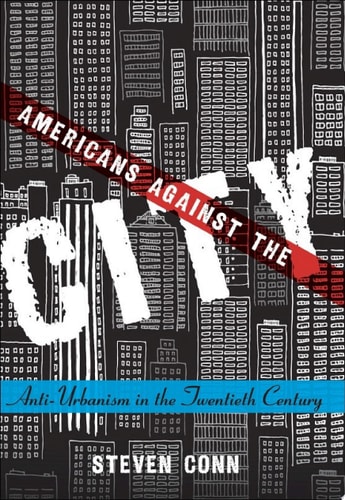
Americans Against the City: Anti-Urbanism in the Twentieth Century
0
0
As an Amazon Associate and affiliate partner, Menrva Books earns from qualifying purchases. Learn more
Author Description
It is a paradox of American life that we are a highly urbanized nation filled with people deeply ambivalent about urban life. An aversion to urban density and all that it contributes to urban life, and a perception that the city was the place where "big government" first took root in America fostered what historian Steven Conn terms the "anti-urban impulse." In response, anti-urbanists called for the decentralization of the city, and rejected the role of government in American life in favor of a return to the pioneer virtues of independence and self-sufficiency. In this provocative and sweeping book, Conn explores the anti-urban impulse across the 20th century, examining how the ideas born of it have shaped both the places in which Americans live and work, and the anti-government politics so strong today. Beginning in the booming industrial cities of the Progressive era at the turn of the 20th century, where debate surrounding these questions first arose, Conn examines the progression of anti-urban movements.: He describes the decentralist movement of the 1930s, the attempt to revive the American small town in the mid-century, the anti-urban basis of urban renewal in the 1950s and '60s, and the Nixon administration's program of building new towns as a response to the urban crisis, illustrating how, by the middle of the 20th century, anti-urbanism was at the center of the politics of the New Right. Concluding with an exploration of the New Urbanist experiments at the turn of the 21st century, Conn demonstrates the full breadth of the anti-urban impulse, from its inception to the present day. Engagingly written, thoroughly researched, and forcefully argued, Americans Against the City is important reading for anyone who cares not just about the history of our cities, but about their future as well.
Menrva's Summary
THE THESIS
This book investigates the persistent paradox of American anti-urbanism and how a deep-seated cultural aversion to city density has fundamentally shaped the nation's political and physical landscape throughout the twentieth century. Historian Steven Conn examines the intellectual and social history of the anti-urban impulse, tracing its development from the Progressive era through the rise of the New Right. By analyzing the intersection of urban planning, government policy, and political ideology, Conn argues that the rejection of the city is inextricably linked to broader American anxieties regarding big government and individual self-sufficiency.
THE SCOPE MAP
What You Will Find
- Historical analysis of the decentralist movement of the 1930s and mid-century small-town revival efforts.
- Examination of the anti-urban motivations behind urban renewal programs in the 1950s and 1960s.
- Investigation into the Nixon administration's new town initiatives as a response to the urban crisis.
- Exploration of New Urbanist experiments at the turn of the 21st century.
- Primary source research connecting architectural trends to the political philosophy of the New Right.
THE AUTHORITY PERSPECTIVE
Experts recognize this work as a significant contribution to the study of American political culture and urban history. Readers frequently note the clarity of Conn's prose and the logical progression of his argument regarding the influence of anti-urban sentiment on contemporary political discourse.
Page Count:
393
Publication Date:
2014-01-01
Publisher:
Oxford University Press
ISBN-10:
0199973687
ISBN-13:
9780199973682
History
Architecture
Special Topics
Sociology
Decentralization in government
Urban renewal
American History
Urban Studies
Community Tags
Other Editions(2)

Similar Books















Reader Comments
Share Your Thoughts
No comments yet. Be the first to share your thoughts!