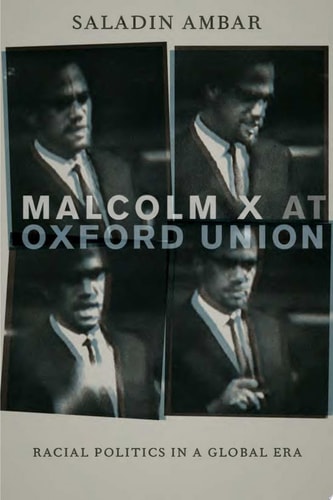
Malcolm X at Oxford Union: Racial Politics in a Global Era
0
0
As an Amazon Associate and affiliate partner, Menrva Books earns from qualifying purchases. Learn more
Author Description
In 1964 Malcolm X was invited to debate at the Oxford Union Society at Oxford University. The topic of debate that evening was the infamous phrase from Barry Goldwater's 1964 Republican Convention speech:"Extremism in the defense of liberty is no vice; moderation in the pursuit of justice is no virtue." At a time when Malcolm was traveling widely and advocating on behalf of blacks in America and other nations, his thirty minute speech at the Oxford Union stands out as one of the great addresses of the civil rights era.Delivered just months before his assassination, the speech followed a period in which Malcolm had traveled throughout Africa and much of the Muslim world. The journey broadened his political thought to encompass decolonization, the revolutions underway in the developing world, and the relationship between American blacks and non-white populations across the globe-including England.Facing off against debaters in one of world's most elite institutions, he delivered a revolutionary message that tackled a staggering array of issues: the nature of national identity; US foreign policy in the developing world; racial politics at home; the experiences of black immigrants in England; and the nature of power in the contemporary world. It represents a moment when his thought had advanced to its furthest point, shedding the parochial concerns of previous years for an increasingly global and humanist approach to ushering in social change.Set to publish near the fiftieth anniversary of his death, Malcolm X at Oxford Union will reshape our understanding not only of the man himself, but world politics both then and now.
Menrva's Summary
THE THESIS
This book investigates the significance of Malcolm X's 1964 Oxford Union debate as a pivotal moment that signaled his transition toward a global, humanist political framework. Author Saladin M. Ambar, a scholar of political science, utilizes historical transcripts, biographical context, and geopolitical analysis to argue that this specific address represents the intellectual maturation of Malcolm X. By situating the speech within the broader context of his travels through Africa and the Middle East, the text demonstrates how his rhetoric evolved to address decolonization and international racial solidarity.
THE SCOPE MAP
What You Will Find
- Analysis of the 1964 Oxford Union debate regarding the ethics of extremism and moderation.
- Examination of Malcolm X's evolving political ideology following his international travels.
- Discussion of the intersection between American civil rights and global decolonization movements.
- Contextualization of the speech within the final months of Malcolm X's life and his shifting views on national identity.
THE AUTHORITY PERSPECTIVE
Scholars and historians recognize this work as a focused, rigorous examination of a specific, high-stakes rhetorical event. Readers frequently note the academic density of the prose and the author's success in connecting a singular debate to the broader currents of twentieth-century global politics.
Page Count:
242
Publication Date:
2014-02-10
Publisher:
Oxford University Press
ISBN-10:
0199975477
ISBN-13:
9780199975471
History
Biography
United States
African Americans
Oxford Union
Civil Rights
Politics & Government
Community Tags
Other Editions(2)
Similar Books