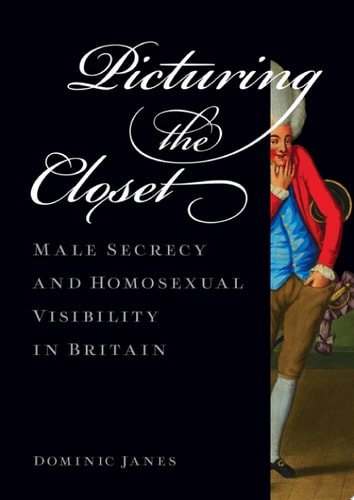
Picturing the Closet: Male Secrecy and Homosexual Visibility in Britain
0
0
As an Amazon Associate and affiliate partner, Menrva Books earns from qualifying purchases. Learn more
Author Description
To what extent did people think they could identify an 'obvious' sodomite before the construction of the homosexual as a type of person during the latter part of the nineteenth century? What role did secrecy and denial play in relation to the visual expression of same-sex desire before the term 'the closet' came into widespread use in the latter part of the twentieth century? And what, therefore, did sodomites/homosexuals/gays/queers look like in Britain in 1700, 1800, 1900 and 2000? Could they be spotted mincing down the street? Or were such as these just the flamboyant few whose presence conveniently drew attention away from the many others who wanted to appear 'normal'? These issues are not peripheral to the struggle of the last several decades for individual self-determination and self-expression. It was this set of cultural constructions that the pioneering writer Eve Kosofsky Sedgwick (1950-2009) attacked in her book Epistemology of the Closet as representing 'the defining structure for gay oppression in this century'. This book represents a visual culture counterpart to Sedgwick's study and aims, through the use of a series of interdisciplinary case-studies, to explore both the pre-history of the closet since the eighteenth century and its evolution through to the present day. Chapters explore key moments and issues within the British cultural experience and make pioneering use of a wide range of source materials ranging from art to fashion, literature, philosophy, theology, film and archival records.
Menrva's Summary
THE THESIS
This book investigates how same-sex desire was visually perceived and constructed in Britain from the eighteenth century to the present, questioning the historical development of the 'closet' as a social and cultural mechanism. Dominic Janes, a scholar of visual culture and history, utilizes an interdisciplinary framework to examine how the visibility of homosexual individuals evolved alongside shifting societal norms. By analyzing the tension between flamboyant stereotypes and the desire for normalcy, the author challenges the assumption that the 'closet' is a static concept, instead positioning it as a dynamic structure of oppression and identity formation.
THE SCOPE MAP
What You Will Find
- A chronological analysis of visual representations of same-sex desire in Britain from 1700 to 2000.
- Interdisciplinary case studies incorporating art, fashion, literature, philosophy, and theology.
- An exploration of the 'pre-history' of the closet prior to the late twentieth-century terminology.
Scope Limits
- The analysis is geographically restricted to the British cultural experience.
- The study focuses primarily on male secrecy and visibility rather than a comprehensive history of all queer identities.
THE AUTHORITY PERSPECTIVE
Scholars and readers recognize this work as a significant visual-culture companion to foundational queer theory texts like Eve Kosofsky Sedgwick's Epistemology of the Closet. The text is noted for its academic rigor and its ability to synthesize diverse archival materials into a coherent historical argument.
Page Count:
240
Publication Date:
2015-04-01
Publisher:
Oxford University Press
ISBN-10:
0190205636
ISBN-13:
9780190205638
History
Gays
Visual Culture
British History
Sociology
Gay Men
LGBTQ Studies
Community Tags
Similar Books