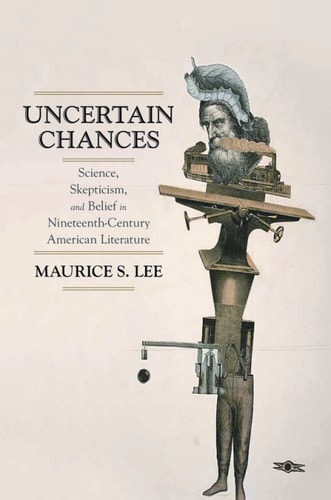
Uncertain Chances: Science, Skepticism, and Belief in Nineteenth-Century American Literature
0
0
As an Amazon Associate and affiliate partner, Menrva Books earns from qualifying purchases. Learn more
Author Description
The role of chance changed in the nineteenth century, and American literature changed with it. Long dismissed as a nominal concept, chance was increasingly treated as a natural force to be managed but never mastered. New theories of chance sparked religious and philosophical controversies while revolutionizing the sciences as probabilistic methods spread from mathematics, economics, and sociology to physics and evolutionary biology. Chance also became more visible in everyday life, as Americans attempted to control its power through weather forecasting, insurance policies, military strategy, and financial dealings.Uncertain Chances shows how the rise of chance shaped the way nineteenth-century American writers confronted questions of doubt and belief. Poe's detective fiction critiques probabilistic methods; Melville's works struggle to vindicate moral action under conditions of chance; Douglass and other African American authors fight against statistical racism; Thoreau learns to appreciate the play between nature's randomness and order; and Dickinson works faithfully to render poetically the affective experience of chance-surprise. These and other nineteenth-century writers dramatize the inescapable dangers and wonderful possibilities of chance. Their writings even help to navigate extremes that remain with us today--fundamentalism and relativism, determinism and chaos, terrorism and risk-management, the rational confidence of the Enlightenment and the debilitating doubts of modernity.
Menrva's Summary
THE THESIS
This book investigates how the emergence of probabilistic thinking and the concept of chance transformed nineteenth-century American literature and intellectual life. Maurice S. Lee, a scholar of American literature, utilizes a multidisciplinary framework to examine how writers navigated the tension between scientific randomness and human attempts to impose order. He argues that the shift toward viewing chance as a natural force fundamentally altered how authors addressed themes of doubt, belief, and moral agency.
THE SCOPE MAP
What You Will Find
- Analysis of probabilistic methods in mathematics, economics, and evolutionary biology
- Examination of cultural practices like weather forecasting, insurance, and military strategy
- Literary case studies of Poe, Melville, Douglass, Thoreau, and Dickinson
- Exploration of the dichotomy between determinism and chaos
Scope Limits
- Does not provide a comprehensive history of probability theory outside of its impact on American literary production
- Does not focus on twentieth-century developments in quantum mechanics or modern chaos theory
THE AUTHORITY PERSPECTIVE
Scholars recognize this text as a significant contribution to the intersection of literary studies and the history of science. Readers frequently note the academic density of the prose, which effectively bridges the gap between technical scientific history and textual analysis.
Page Count:
250
Publication Date:
2011-01-01
Publisher:
Oxford University Press
ISBN-10:
0190208538
ISBN-13:
9780190208530
Philosophy
English
English & College Success
Science History
American
Literary Criticism
Nineteenth century
Cultural History
Community Tags
Other Editions(2)
Similar Books