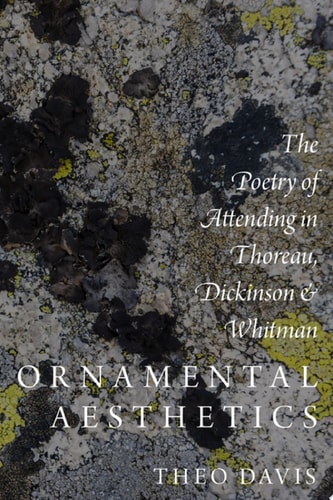
Ornamental Aesthetics: The Poetry of Attending in Thoreau, Dickinson, and Whitman
0
0
As an Amazon Associate and affiliate partner, Menrva Books earns from qualifying purchases. Learn more
Author Description
Ornamental Aesthetics offers a theory of ornamentation as a manner of marking out objects for notice, attention, praise, and a means of exploring qualities of mental engagement other than interpretation and representation. Although Thoreau, Dickinson, and Whitman were hostile to the overdecorated rooms and poems of nineteenth-century culture, their writings are full of references to chandeliers, butterflies, diamonds, and banners which indicate their primary investment in ornamentation as a form of attending. Theo Davis argues that this essential quality of ornamentation has been obscured by the enduring emphasis of literary studies on the structure of representation, and on how meaning is embodied in material form. Thoreau, Dickinson, and Whitman's sense of ornamentation as a manner of attending is grounded in an understanding of poetry as an adornment to the world, and thus as a way of relating to what is present rather than of representing it. Ornamental Aesthetics investigates the aesthetic practices of Thoreau, Dickinson, and Whitman through readings of the writings of Martin Heidegger, which also presents the human mind as an agitated, responsive, and ornamental presence. Drawing together work in poetics, rhetoric, philosophy, and nineteenth-century American literature, Ornamental Aesthetics ultimately argues that the kinds of immediate experience of attending which concerns ornamentation should retain a central place in the study of literature and the humanities more broadly.
Menrva's Summary
THE THESIS
This book investigates how ornamentation functions as a specific mode of mental engagement and attention in the works of Thoreau, Dickinson, and Whitman, rather than merely serving as a decorative element. Theo Davis, a scholar of nineteenth-century American literature, challenges the traditional literary focus on representation and meaning-making. By integrating the philosophical framework of Martin Heidegger, Davis argues that these poets utilized ornamentation to relate directly to the presence of objects in the world, positioning the human mind as an inherently responsive and ornamental entity.
THE SCOPE MAP
What You Will Find
- A theoretical re-evaluation of ornamentation in nineteenth-century American poetry.
- Comparative analysis between the writings of Thoreau, Dickinson, and Whitman and the philosophy of Martin Heidegger.
- An exploration of how poetic adornment facilitates immediate experience rather than symbolic representation.
Scope Limits
- The study does not provide a comprehensive history of nineteenth-century decorative arts or material culture.
- It does not focus on biographical details of the authors, prioritizing instead their aesthetic and philosophical practices.
THE AUTHORITY PERSPECTIVE
Scholars recognize this text as a significant intervention in the study of American poetics and aesthetic theory. Readers frequently note the academic density of the prose, which requires a strong background in both literary criticism and continental philosophy to fully navigate.
Page Count:
257
Publication Date:
2016-01-01
Publisher:
Oxford University Press
ISBN-10:
0190628650
ISBN-13:
9780190628659
Philosophy
Poetry
Literary Criticism
American
Aesthetics
English & College Success
New Used & Rental Textbooks
English
Nineteenth century
Community Tags
Similar Books