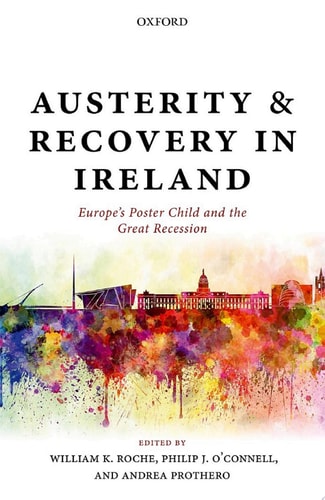
Austerity and Recovery in Ireland: Europe's Poster Child and the Great Recession
0
0
As an Amazon Associate and affiliate partner, Menrva Books earns from qualifying purchases. Learn more
Author Description
In international commentary and debate on the effects of the Great Recession and austerity, Ireland has been hailed as the poster child for economic recovery and regeneration out of deep economic and fiscal contraction. While the genesis of Ireland's financial, economic, and fiscal crisis has been covered in the literature, no systematic analysis has yet been devoted to the period of austerity, to the impact of austerity on institutions and people, or to the roots of economic recovery. In this book a group of Ireland's leading social scientists present a multidisciplinary analysis of recession and austerity and their effects on economic, business, political, and social life. Individual chapters discuss the fiscal and economic policies implemented, the role of international, and, in particular, of EU institutions, and the effects on businesses, consumption, work, the labour market, migration, political and financial institutions, social inequality and cohesion, housing, and cultural expression. The book shows that Ireland cannot be viewed uncritically as a poster child for austerity. While fiscal contraction provided a basis for stabilizing the perilous finances of the state, economic recovery was due in the main to the long-established structure of Irish economic and business activity, to the importance of foreign direct investment and the dynamic export sector, and to recovery in the international economy. The restructuring and recovery of the financial system was aided by favourable international developments, including historically low interest rates and quantitative easing. Migration flows, nominal wage stability, the protection of social transfer payments, and the involvement of trade unions in severe public sector retrenchment - long-established features of Irish political economy - were of critical importance in the maintenance of social cohesion.
Menrva's Summary
THE THESIS
This book investigates whether Ireland's status as a successful model of economic recovery during the Great Recession is empirically justified or a misinterpretation of complex fiscal and social factors. The authors, a team of prominent Irish social scientists, utilize a multidisciplinary framework to analyze the intersection of austerity measures, institutional stability, and broader economic trends. They argue that while fiscal contraction played a role in stabilization, the recovery was primarily driven by pre-existing economic structures, foreign direct investment, and favorable international conditions rather than austerity alone.
THE SCOPE MAP
What You Will Find
- Analysis of fiscal and economic policies implemented during the Irish financial crisis.
- Examination of the role played by the European Union and international financial institutions.
- Assessment of the impact of austerity on labor markets, migration, housing, and social inequality.
- Evaluation of the role of trade unions and social transfer payments in maintaining social cohesion.
Scope Limits
- The text does not provide a comprehensive history of the origins of the crisis, focusing instead on the subsequent period of austerity and recovery.
- The analysis is geographically constrained to the Republic of Ireland and its specific institutional responses.
THE AUTHORITY PERSPECTIVE
Experts recognize this work as a critical, evidence-based counter-narrative to the simplified 'poster child' rhetoric often found in international media. Readers frequently note the academic rigor and the breadth of the multidisciplinary approach, which provides a nuanced understanding of the Irish political economy.
Page Count:
368
Publication Date:
2016-01-01
Publisher:
OUP Oxford
ISBN-10:
0192510797
ISBN-13:
9780192510792
Economics
History
Sociology
Economics history
Public Policy
European History
Ireland
Community Tags
Similar Books



Reader Comments
Share Your Thoughts
No comments yet. Be the first to share your thoughts!