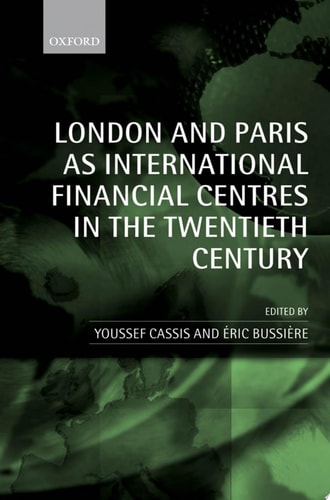
London and Paris as International Financial Centres in the Twentieth Century
0
0
As an Amazon Associate and affiliate partner, Menrva Books earns from qualifying purchases. Learn more
Author Description
London and Paris, the world's two leading financial centres in the nineteenth century, experienced differing fortunes during the twentieth century. While London remained an international financial centre, Paris' influence declined. Yet over the last twenty years deregulation, internationalization, and the advent of the single currency have reactivated their competition in ways reminiscent of their old rivalry before the First World War. This book provides a long-term perspective on the development of each centre, with special attention devoted to the pre-1914 years and to the last decades of the twentieth century, in order to contrast these two eras of globalization. The chapters include both archive-based and synthetic surveys and are written by the leading specialists of the field. This comparison between Europe's two leading capital cities will also provide new insights into two important subjects: the political economy of Britain and France in the twentieth century, and the history of international financial centres. As much as a comparison between London and Paris as international financial centres, this book is an Anglo-French comparison; in other words, it considers, through the prism of finance, several aspects of the two countries' economic, business, social, and political histories. It includes contributions from leading banking, financial, and economic historians, and will be of interest to academics, researchers, and students of Financial and Economic History, and the role of London and Paris in particular.
Menrva's Summary
THE THESIS
This book investigates the divergent trajectories of London and Paris as international financial centres throughout the twentieth century, questioning why London maintained its global prominence while Paris experienced a relative decline. The authors, Youssef Cassis and Eric Bussière, curate a collection of essays from leading specialists in economic and financial history. By utilizing archival data and synthetic surveys, the text provides a comparative framework that contrasts the era of globalization before the First World War with the deregulated, integrated financial landscape of the late twentieth century.
THE SCOPE MAP
What You Will Find
- Comparative analysis of London and Paris financial markets from 1900 to 2000
- Examination of the impact of deregulation, internationalization, and the single currency
- Historical assessment of the political economy of Britain and France
- Multi-disciplinary perspectives on economic, business, and social history
Scope Limits
- The text focuses primarily on the Anglo-French comparison rather than a global survey of all financial hubs
- It does not provide a comprehensive technical manual for modern financial trading practices
THE AUTHORITY PERSPECTIVE
Experts highlight this work as a foundational comparative study for students and researchers of European economic history. Readers frequently note the academic density of the prose, which provides a rigorous, evidence-based analysis of the institutional and political factors shaping these two capital cities.
Page Count:
380
Publication Date:
2005-01-01
Publisher:
OUP Oxford
ISBN-10:
0191533475
ISBN-13:
9780191533471
European History
Finance
Economic History
Economics history
Money & BankingMonetary Theory
Business History
Community Tags
Similar Books