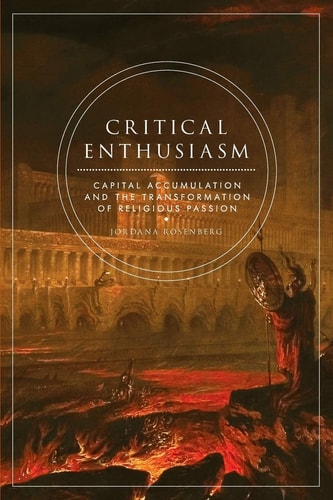
Critical Enthusiasm: Capital Accumulation and the Transformation of Religious Passion
0
0
As an Amazon Associate and affiliate partner, Menrva Books earns from qualifying purchases. Learn more
Author Description
The Atlantic world of the long eighteenth century was characterized by two major, interrelated phenomena: the onset of capital accumulation and the infusion of traditions of radical religious rapture into Enlightenment discourses. In exploring these cross-pollinations, Critical Enthusiasm shows that debates around religious radicalism are bound to the advent of capitalism at its very root: as legal precedent, as financial rhetoric, and as aesthetic form. To understand the period thus requires that we not only contextualize histories of religion in terms of the economic landscape of early modernity, but also recast the question of secularization in terms of the contradictions of capitalism.Critical Enthusiasm contributes to new directions of scholarship in literary and legal history, secularization studies, and economic criticism. It is unique in producing a model for literary and cultural study that is simultaneously attuned to economic and religious forces. By approaching the history of capitalism through religious debates, Critical Enthusiasm discloses significant intersections of aesthetic form and of financial flows that have been hitherto ignored. Through chapters that highlight moral philosophy, religious prophesy, early modern statute law, poetry, and political theory, Rosenberg shows that the contested nature of enthusiastic rapture is crucial to understanding the major institutional transformations of early modernity. These transformations--colonial plunder, the rise of finance, the administration of racialized labor, and the legal reform that justified such practices--shaped the period; they also laid the foundation for our contemporary world.
Menrva's Summary
THE THESIS
This book investigates the foundational relationship between the rise of capital accumulation and the persistence of radical religious enthusiasm during the long eighteenth century. Jordana Rosenberg, a scholar of literary and legal history, argues that the development of capitalism was not a purely secular process but was deeply intertwined with religious rhetoric and aesthetic forms. By analyzing legal precedents, financial discourse, and moral philosophy, she posits that the contradictions inherent in early modern capitalism were articulated through the language of religious rapture.
THE SCOPE MAP
What You Will Find
- Analysis of the Atlantic world during the long eighteenth century.
- Examination of the intersection between religious prophecy and early modern statute law.
- Investigation into the role of racialized labor and colonial plunder in economic development.
- A framework for understanding secularization through the lens of economic and religious contradictions.
THE AUTHORITY PERSPECTIVE
Scholars in the fields of literary history and economic criticism identify this work as a significant contribution to the study of early modernity. Readers frequently note the academic density of the prose and the complexity of the author's interdisciplinary approach to cultural and financial history.
Page Count:
232
Publication Date:
2013-09-01
Publisher:
Oxford University Press
ISBN-10:
019932882X
ISBN-13:
9780199328826
History
Religion
Philosophy
Economics
English & College Success
English
European History
Economics
Enthusiasm
Great Britain
Literary Criticism
Economics history
Community Tags
Similar Books