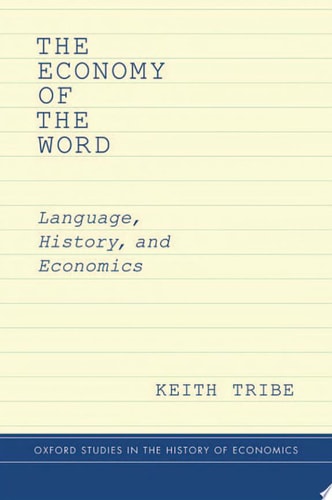
The Economy of the Word
0
0
As an Amazon Associate and affiliate partner, Menrva Books earns from qualifying purchases. Learn more
Author Description
It Was Only In The Sixteenth Century That Texts Began To Refer To The Significance Of Economic Activity -- Of Sustaining Life. This Was Not Because The Ordinary Business Of Life Was Thought Unimportant, But Because The Principles Governing Economic Conduct Were Thought To Be Obvious Or Uncontroversial. The Subsequent Development Of Economic Writing Thus Parallels The Development Of Capitalism In Western Europe. From The Seventeenth To The Twenty-first Century There Has Been A Constant Shift In Content, Audience, And Form Of Argument As The Literature Of Economic Argument Developed. The Economy Of The Word Proposes That To Understand The Various Forms That Economic Literature Has Taken, We Need To Adopt A More Literary Approach In Economics Specifically, To Adopt The Instruments And Techniques Of Philology. This Way We Can Conceive The History Of Economic Thought To Be An On-going Work In Progress, Rather Than The Story Of The Emergence Of Modern Economic Thinking. This Approach Demands That We Pay Attention To The Construction Of Particular Texts, Showing The Work Of Economic Argument In Different Contexts. In Sum, We Need To Pay Attention To The Economy Of The Word. The Economy Of The Word Is Divided Into Three Parts. The First Explains What The Term Economy Has Meant From Antiquity To Modernity, Coupling This Conceptual History With An Examination Of How The Idea Of National Income Was Turned Into A Number During The First Half Of The Twentieth Century. The Second Part Is Devoted To Adam Smith's Wealth Of Nations, Considering First The Manner In Which Smith Deals With International Trade, And Then The Way In Which The Book Was Read In The Course Of The Nineteenth Century. Part Iii Examines The Sources Used By Karl Marx And Léon Walras In Developing Their Economic Analysis, Drawing Attention To Their Shared Intellectual Context In French Political Economy.
Menrva's Summary
THE THESIS
This book investigates how the history of economic thought can be re-evaluated by applying the techniques of philology to the construction and context of economic texts. Keith Tribe, a scholar of economic history, argues that economic literature has evolved alongside Western capitalism, shifting in form and audience over several centuries. He proposes that by analyzing the specific linguistic and structural composition of these texts, researchers can view the history of economics as an ongoing, evolving project rather than a linear progression toward modern theory.
THE SCOPE MAP
What You Will Find
- A conceptual history of the term 'economy' from antiquity to the twentieth century.
- An analysis of the quantification of national income during the early twentieth century.
- A detailed examination of Adam Smith's 'Wealth of Nations' and its nineteenth-century reception.
- A comparative study of the intellectual sources utilized by Karl Marx and Léon Walras.
Scope Limits
- The text does not provide a comprehensive history of all economic theories.
- It does not focus on the mathematical validity of economic models, but rather on their textual and historical origins.
THE AUTHORITY PERSPECTIVE
Scholars in the history of economic thought recognize this work as a significant methodological intervention that challenges traditional historiography. Readers frequently note the academic density of the prose and the author's rigorous focus on the philological roots of economic discourse.
Page Count:
368
Publication Date:
2015-01-01
Publisher:
Oxford University Press
ISBN-10:
0190211628
ISBN-13:
9780190211622
Non-Fiction
Economics
Literary Criticism
Philology
Economic History
Community Tags
Similar Books